Forward to 1.1.3 Fertile Crescent – 1.2 Medieval
Back to 1.1.1 Art in Antiquity Index – 1.1 Antiquity and Classical – 1.0 Art and Sculpture
[1129-10]
 Image source: Wikimedia commons [1129-11] | One of the earliest Chinese scripts have been found inscribed on ‘Oracle Bones’ – cattle bones and turtle plastrons. This one is a late Shang artefact from 1,600-1,046 BCE. There is no evidence of any earlier usage, though it is assumed. Some 4,300 characters have been noted from the 160,000 oracle bones discovered, but only 1,600 (37%) have yet been deciphered. |
 Image source: Wikimedia commons [1129-12] | The Shang and Zhou created new scripts to inscrbie on their bronzes ronze inscriptions – Zhou used 100 to at most 500 characters. Pictured is the set of bronze biānzhōng bells that were found in 1978 from the early Warring States Tomb of Marquis Yĭ of Zēng. These bear inscriptions using over 2,800 characters. As memorable today for being on show at Wuhan’s Provincial Museum, the origin of the Covid-19 pandemic. |
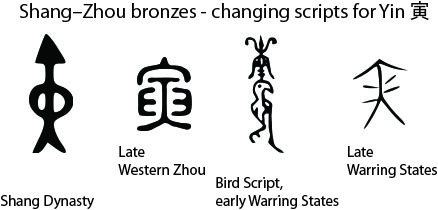 Image source: khanacademy.org [1129-13] On bronze inscriptions, across the 1,400 years of the Shang and Zhou dynasties. |
| Yin is the female and mysterious side of Chinese philosophy’s two forces, Yin and Yang. Today they are depicted as:  |
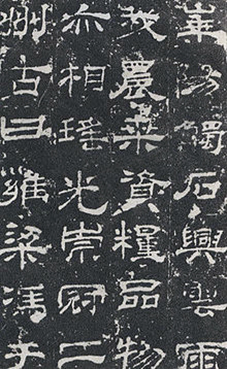 Image source: Wikimedia commons [1129-14] | The ‘Clerical’ script emerged during the Warring States period and evolved through the Qin and Han dynasties. Its rectilinear high legibility for modern readers means it it is still used to add an artistic flavor to headlines, signboards, and advertisements. Its highly rectilinear structure is a feature shared with modern kaishu script. |
 Image source: courses.lumenlearning.com [1129-15] | The Qin Dynasty prime minister, Li Si (c280-208 BCE), standardised the writing system alongside his regularisation of weights, measures, currencies. He made it a uniform size and shape across the whole country. This lasted for thousands of years. Li Si is also credited with creating, or at least promulgating, the Small Seal Script (opposite). This provided the basis for the modern Chinese writing system. A primer, the Cangjiepian, aka Three Chapters, was distributed showing 3,300 characters. This script is still in use today for cards, posters, and advertising today. |
 Image source: Wikimedia commons [1129-16] | The Cursive style evolved during the Han and Jiu dynasties. This sought to speed up writing by omitting part of a symobol, or merging strokes together, by replacing portions with abbreviated forms (as for example using one stroke to replace four dots), or modifying the stroke styles. This is Mi Fu’s (1051-1107 CE) written discourse about the cursive style On Calligraphy. |
 Image source: Wikimedia commons [1129-17] | Semi-cursive script is not as abbreviated as cursive script, most people who can read regular script can read semi-cursive. Writing it was quicker. For a long time after its development in the 1st centuries AD the standard style of handwriting. These characters show regular script on the left and the semi-cursive equivalent on the right. Image source: Wikimedia commons |
 Image source: khanacademy.org [1129-18] | Running script is another name fr semi-cursive, it was used from the Han to the 4th c CE. It became a popular form of Chinese freehand writing for everyday use. |


Forward to 1.1.3 Fertile Crescent – 1.2 Medieval
Back to 1.1.1 Art in Antiquity Index – 1.1 Antiquity and Classical – 1.0 Art and Sculpture


