Malbec: Back to Winemaking – Back to Grapes – Back to Countries
Top thirteen grapes:
Reds – Cabernet Franc – Cabernet Sauvignon – Malbec – Merlot –
Whites – Chardonnay – Gewürztraminer – Muscat –
Pinot blanc – Pinot gris – Riesling – Sauvignon blanc
Next twenty-five grapes:
Reds – Barbera – Carignan – Gamay – Grenache – Mourvèdre – Petit Verdot –
Sangiovese – Tannat – Tempranillo – Touriga Nacional – Zweigelt
Whites – Albariño – Aligoté – Arinto – Chenin blanc – Malvasia –
Müller-Thurgau – Muscat-Ottonel – Sémillon – Tămâioasă Românească –
Traminer – Ugni-blanc – Viognier – Welschriesling
– and Cava
| One theory claimed that Malbec was named after a Hungarian peasant who spread the grape variety throughout France. Malbec is frequently mixed with Merlot and Tannat to make dark, full-bodied wines, though more recently 100% Malbec varietal wines are produced. Malbec is one of the six grapes allowed in the blend of red Bordeaux wine – it is very much the minor partner to Cabernet Sauvignon, Merlot, Cabernet Franc and Petit Verdot. The sixth, Carménère, has a second focus in Chile, but is also low on the hierarchy of permitted Bordeaux grapes. 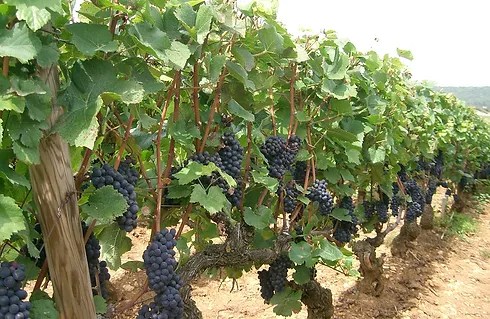 Image source: malbecsupplies.com Malbec is mainly grown in such outlying parts of Bordeaux as Bourg, Blaye and Entre-Deux-Mers. Plantations of Malbec are also significant in Cahors in South West France (200km east of Bordeaux), it is known here as Auxerrois or Côt. Cahor regulations stipulate a minimum of 70% of Malbec/ Auxerrois/Côt. The traditional vineyards are found on the plateaux above the river Garonne. In the Loire Malbec is blended with Cabernet Franc and Gamay. Malbec was introduced to Mendoza Argentina by French agricultural engineer Michel Aimé Pouget in 1868. He arrived with Malbec cuttings and it is now widely planted in Argentina. Ampelography (the study of grape varieties and their characteristics) suggests that Côt was the variety’s original name and that it probably originated in northern Burgundy. Eleanor of Aquitaine (1122-1204) had been married to Louis VII and was Queen of France. He died in 1152 and that same year she remarried King Henry II of England. Reputedly they had Malbec served at their wedding. Their son, later became King Henry III of England, forbade Bordeaux merchants from restricting exports by taxing Cahors Malbec. Pope John XXII (1249-1334), was born in Cahors and, when the Papacy was moved from Rome to Avignon (1309-1377), John used wines from Cahors as the sacramental wine. In Bordeaux the severe winter of 1956 killed 75% of Malbec vines and, then, more glamorous alternatives were selected for replanting. DNA shows this was a natural cross of Prunelard (father) from Gaillac, Toulouse and Magdeleine des Charentes (mother) from Montpellier (200kms east). |
Taste/smell: Oz Clarke defines Cahors Malbec as dark purple in colour with aromas of damsons, tobacco, garlic, and raisin. Others suggest it has notes of Blackberry, Bramble, Mulberry, Red berries, Red plum; and of Black pepper, Cocoa, Coffee, Leather, Smoke, Tobacco and Vanilla. Varieties/Mutations  Image source: The Catena Institute Investigations suggest that there are two clonal varieties most likely generated as it was moved to Argentina. UC Davis compared sixteen Californian vineyards and twenty-six from Mendoza Argentina. They concluded that there were distinct differences, for example in flavour. It experiences various grape diseases and hazards – frost, coulure, downey mildew, and rot. But the development of clones and changes in vineyard management have managed to control some of these problems. Malbec argenté is a variety of the southwestern French grape Abouriou. |  Description: Image source: wikimedia commons The Malbec grape is a thin-skinned grape that produces full-flavoured, fruity reds. It produces medium tannins and medium acidity. It requires more sun and heat than either Cabernet Sauvignon or Merlot to fully ripen, usually in mid-season. Its berries are medium-sized, round and purple-black. Malbec features a deep colour, its berries are medium-sized, round and purple-black. It has ample tannin and a plum-like flavour component which adds complexity to claret blends. Sometimes, especially in its traditional growing regions, it is not trellised but is cultivated as a bush vine (the goblet system) because this creates rich, dark and juicy grapes.   Image source: UC Davis Leaves are medium-sized, with three lobes, each with sparse tufted hairs on the underside. Young shoots have bronze-red features and are downy white. |
| Malbec producing countries: Big Five Producers: (overall 42% of vineyards, 64% of wine production and 41% of wine consumption – OIV 2022) Spain: Castilla y León. France: Bordeaux, Cahors (aka Côt) and Loire. Italy: Abruzzo, Apulia, Friuli-Venezia Giulia, Sardinia, Sicily, Tuscany, Umbria USA: Washington. Chile: Maipo Valley. Next Ten Largest Producers: (with big five, responsible overall for 75% of vineyards, 88% of wine production, 64% of wine consumption – OIV 2022) Argentina: Buenos Aires, Catamarca, Jujuy, La Pampa, La Rioja, Mendoza, Patagonia, Salta, San Juan, and Tucumán. Australia: Margaret River, McLaren Vale, Rutherglen, Hunter Valley, Orange, Mudgee, Granite Belt and Swan Hill (regions!). China: Ningxia.. Germany: none found. India: none found. New Zealand: Hawkes Bay. Portugal: none found. Romania: none found. South Africa: Swartland. Turkey: Aegean and Southeast Anatolia. Others countries growing Cabernet/Franc: Brazil, Moldova, Peru, Uruguay  Somewhat outdated chart (from 2010!) Image source: winefolly.com |  Image source: southamericawineguide.com Grape is also known as: French ampelographer Pierre Galet documented over a thousand different synonyms for Malbec , it had at one time been present in 30 départements of France. Agreste, Aneroir, Ausseres, Auxerrois, Auxerrois de Laquenexy, Auxerrois des Moines de Picpus, Auxerrois du Mans, Balouzat, Beran, Beraou, Besparo, Blanc de Kienzheim, Bordelais Noir, Boucraes, Bouchalès, Bourguignon Noir, Bouyssales, Bouyssalet, Bouyssaledes, Cagors, Cahors, Calarin, Cau, Cauli, Cauly, Claverie noire, Cog rouge, Coly, Cor, Cors, Cos, Costa Rosa, Costa Rossa, Costo roujo, Côt, Côt de Bordeaux, Côt de Pays, Côt de Touraine, Côt Malbec, Côt rouge, Côt à Queue rouge, Côt à Queue verte, Cote rouge, Cotes rouges, Cots, Cruchinet, Doux noir, Estrangey, Étranger, Étranger Petit, Etrangey, Franc Moreau, Gôt Noir, Gourdaux, Gourdoux, Grand Vesparo, Grelot de Tours, Grifforin, Gros Auxerrois, Gros noir, Gros Pied rouge, Grosse Merille, Guillan, Hourcat, Jacobain, Jacobin, Jacohin, Luckens, Lutkens, Magret, Malbec, Malbec à Queue Rouge, Malbech, (South America), Malbeck, Malbek, Mancin, Margrot, Médoc Noir (Hungary), Monrame, Mouranne, Moustere, Navarien, Navarin, Negre de Prechac, Negre Doux, Negrera, Noir de Chartres, Noir de Pressac, Noir Doux, Nuar de Presac (Moldova), Nyar de Presak, Odzalesi, Oeil de Perdrix, Parde, Perigord, Pied de Perdrix, Pied Doux, Pied noir, Pied rouge, Pied Rouget, Piperdy, Plant d’Arles, Plant du Medoc, Plant de Meraou, Plant De Meraou, Plant du Lot, Plant de Roi, Plant du Roi, Prechat, Pressac, Prolongeau, Prunelat, Prunieral, Quercy, Queue rouge, Quille de Coq, Quille de Coqu, Quille de Coy, Raisin de Co, Romieu, Saint- Émilion, Soumansigne, Teinturier, Teinturin, Terranis, Tinturin, Vesparo, Vesparol… |

Merlt grapes – Image source: decanter.com
Malbec: Back to Winemaking – Back to Grapes – Back to Countries
Top thirteen grapes:
Reds – Cabernet Franc – Cabernet Sauvignon – Malbec – Merlot –
Whites – Chardonnay – Gewürztraminer – Muscat –
Pinot blanc – Pinot gris – Riesling – Sauvignon blanc
Next twenty-five grapes:
Reds – Barbera – Carignan – Gamay – Grenache – Mourvèdre – Petit Verdot –
Sangiovese – Tannat – Tempranillo – Touriga Nacional – Zweigelt
Whites – Albariño – Aligoté – Arinto – Chenin blanc – Malvasia –
Müller-Thurgau – Muscat-Ottonel – Sémillon – Tămâioasă Românească –
Traminer – Ugni-blanc – Viognier – Welschriesling
– and Cava


