Spain: Forward to France – Italy – USA – Chile
Next ten largest – Argentina – Australia – China – Germany – India – New Zealand – Portugal – Romania – South Africa – Turkey
Countries index – Winemaking – Grapes
| Spain: There are more than 135 official wine designations in Spain with 96 DOPs – denominación de origen protegida. We shall look at eightteen wine-growing regions:  |
SPAIN: QUICK LINKS TO SPANISH REGIONS
| Andalucia Aragon Asturias Balears Basque-pais-vasco Canarias Cantabria Castilla-la-mancha Castilla-y-leon | Catalonia Cava Extremadura Galicia Madrid Murcia Navarre Rioja Valencia |
[Anda]
[Cata]
SPAIN – REGION-BY-REGION
| Andalucia Winemaking in Andalusia may have been ‘imported’ by the Greeks, or even earlier, by the Phoenicians, But certainly, by the time of the Romans, wine-making was important in Andalusia.  Areas – Image source: andalucia.com There are over 40,000 hectares of vineyard in Andalucia, producing both wines and fortified wines. It is most famous for Sherry (Fino/Manzanilla)and sweet dessert wine Pedro Ximenez aka PX. Andalucia appellations: DOPs – Condado de Huelva, Jerez [aka Sherry], Lebrija, Málaga and Sierras de Málaga , Manzanilla de Sanlúcar, Montilla-Moriles [Córdoba] and Sierras de Granada. Grapes: Red: Cabernet Franc, Cabernet Sauvignon, Merlot, Syrah and Tempranillo. White: Airén, Chardonnay, Colombard, Doradilla, Garrido Fino, Listán de Huelva, Moscatel de Alejandría, Palomino, Palomino Fino, Pedro Ximénez, Petit Verdot, Romé, Sauvignon blanc, Tintilla de Rota and Zalema.  Jerez de la Frontera – Image source – wine-searcher.com | Catalonia Winemaking began with the Phoenicians, who traded Catalonian Wine with the Egyptians. But it is best known as the birthplace of the sparkling wine Cava – invented here in the early 1870s.  Image source: vineyards.com Catalonia appellations: Alella, Catalunya, Cava, Conca de Barberà, Costers del Segre, Empordà, Montsant, Penedès, Pla de Bages, Priorat, Tarragona, Terra Alta. Grapes: Red: Cabernet Sauvignon, Carignan, Cariñena, Garnacha, Garnatxa Peluda, Monastrell, Samsó, Tempranillo, Trepat, Ull de Llebre. White: Chardonnay, Garnacha blanca, Macabeo, Moscatel de Alejandría, Parellada, Sauvignon blanc, Viura, Xarel-lo.  Image source: britannica.com |
[Arag]
[Cava]
| Aragon Aragon is one of seventeen autonomous communities in Spain. Located in the country’s north, it stretches from the imposing Pyrenees mountains in the south to the expansive central Iberian plateau.  Image source: vineyards.com Aragon appellations: DOPs: Calatayud, Campo de Borja, Cariñena and Somontano (largest and northmost). Others: Bajo Aragón, Pago-Aylés, Ribera del Ebro, Ribera del Gállego-Cinco Villas, Ribera del Jiloca, Ribera del Quelles, Valdejalón and Valle del Cinca Grapes: Red: Cabernet Sauvignon, Carignan/Cariñena, Garnacha, Merlot, Syrah and Tempranillo. White: Chardonnay, Garnacha blanca, Gewürztraminer, Macabeo, Riesling, Sauvignon blanc and Verdejo – plus Cava (Macabeo [or -eu] aka Viura, Parellada, and Xarel-lo).  Zaragoza – Image source: winetourism.com | Cava The Cava name comes not from a place, grape variety or winemaking technique, but from the stone cellars (cavas) in which the wine is matured. The style was first produced in the 1870s, by a Josep Raventós, on his return to Catalonia after a visit to France. Cava can come from various parts of Spain. Aragon, Extremadura, Navarre, Rioja, Pais Vasco and Valencia – from specific demarcated areas to qualify for the DO, though less than 10 percent of Cava comes from these regions. The heart of Cava production is in Catalonia, more specifically from San Sadurní de Noya.  Image source: mag.sommtv.com Cava appellations: Cava Grapes: Red: Garnacha, Monastrell, Pinot noir, Trepat. White: Chardonnay, Macabeo, Malvasía, Parellada, Xarel-lo.  Image source: cava.wine/en/news-articles/ |
[Astu]
[Extr]
| Asturias Vineyards were planted here as early as the 9th c. It was monastic development that led to the spread through the region. Around 1850 the vineyards suffered huge crop losses due to Oidium (powdery mildew). In 1858 there was still 5,493 hectares of vineyards in Asturias, but Phylloxera reduced this figure to 1903 ha 20 years later. Today, there are about nine small wineries based across Asturias.  Image source: vineyards.com Asturias appellations: Cangas (aka Cangas do Morrazo) Grapes: Red: Albarín Negro (Alfrocheiro Preto), Carrasquin, Godello (Verdelho), Mencia, Syrah, Verdejo Negro (Trousseau) White: Albarín Blanco (unrelated to Albariño), Albillo, Gewurztraminer, Godello (Verdelho), Moscatel de Grano Menudo (aka Muscat Blanc à Petits Grains)  Cudillero, Asturias – Image source: thetimes.com | Extremadura: The fourth-largest wine-producing region of Spain, yet quite under-rated. A lot of its grapes used to be sold to Jerez for brandy and sherry. It, and its neighbour Castilla-La Mancha, tended to deal in bulk wines at the cheaper end of the domestic and export markets. It is best-known for its wild black pigs fed on acorns, that are the basis of the famous Jamón Ibérico (Iberian ham).  Image source: vineyards.com Extremadura appellations: One DOP is Ribera del Guadiana – and one VT is Extremadura. This is also an approved Cava production area. Grapes: Red: Alfrocheiro (Portugal), Cabernet Sauvignon, Grenache, Merlot, Syrah, Tempranillo, Touriga Nacional (Portugal), Trincadeira (Portugal) White: Cayetana  Extremadura – Image source: decanter.com |
[Bale]
[Gali]
| Balears/Balearics Wine has been produced on the islands since Roman times, with vines first introduced around 121 BC. The islands are better known for its tourism than for its wines.  Image source: paladarytomar.com Balears appellations: Two DPOs – Binissalem-Mallorce and Plà i Llevant are both on Majorca. The other islands have Ibiza VT, Formentera VT, Illes Beleares VT, Isla de Menorca VT and Mallorca VT. Grapes: Red: Cabernet Sauvignon, Listán Negro, Manto Negro, Merlot, Tempranillo. White: Callet, Chardonnay. Fogoneu, Moll (Prensal Blanc), Palomino  Menorca – Image source: foodandwinetrails.com | Galicia Strabo, talks of vines planted in Galicia and wine-making, here, started with the Roman. It was taken up by monks during the Middle Ages. It includes wine made in the provinces of A Coruña, Lugo, Ourense and Pontevedra. Rías Baixas is the best-known area famous for its Albariño wines.  Image source: vineyards.com Galicia appellations: It has five DOPs – Monterrei, Rias Baixas (with five sub-regions – Condado do Tea, O Rosal, Ribero de Ulla, Soutomajor and Val do Salnés), Ribeiro, Ribeira Sacra, Valdeorras. And, three IGPs – Barbanze e Iria, Betanzos and Val do Miño-Ourense. Grapes: Red: Brancellao, Caíño Tinto, Mencía, Sousón, Valdeorras. White: Albariño, Caíño blanco, Espadeiro, Godello, Lado, Loureiro. Merenzao, Torrontés, Treixadura.  Image source: vineyards.com |
[Basq]
[Madr]
| Basque-pais-vasco/Basque country The region is locally called Euskadi, but to most of the English-speaking world, it is referred to in English as the Basque Country. Wine-making here began in the ancient Roman era. Today it is known its Txakoli wines, which are light, slightly-fruity and zesty white wines, with high acidity and low alcohol content. The traditional way of serving Txakoli wines (pronounced ‘Chac-o-lee’.) is to pour it from a height to increase the fizz and bring out the best in the wine.  Image source: quentinsadler.wordpress.com Basque appellations: El País Vasco is home to three DOPs, Arabako Txakolina, Bizkaiko Txakolina and Getariako Txakolina. It also has a Cava area and Rioja Alavesa (a sub-region of Rioja), Grapes: Red: Hondarrabi Beltza White: Hondarrabi Zuri and Bordeleza Zuria (Folle Blanche), Izkiriota (Gros Manseng), Izkiriota Ttipia (Petit Manseng),  Rioja Alavesa Image source: cellartours.com | Madrid The 16th c was known as the ‘Golden Century’ based upon the Spanish Arts scene. King Philippe II moved the capital from Toledo to Madrid and this saw a remarkable increase in the local wine demand. In the second half of the XVII century, Madrid had 63 wine growers. Phylloxera hit Madrid’s vines in 1914 , since then vine hardiness is favoured over vine diversity.  Image source: vineyards.com Madrid appellations: The Vinos de Madrid DPO waas granted in 1990. It covers three wine sub-regions, each with distinguishing characteristics – Arganda is the largest containing 50% of Madrid’s vineyards, Navalcarnero produces 15% of its wine, and San Martin which has the highest altitude vineyards. Grapes: Red: Cabernet Sauvignon, Garnacha, Merlot, Petit Verdot, Syrah, Tempranillo White: Albillo Real, Malvar, Moscatel, Parellada, Torrontes and Viura.  Madrid – Image source: winetourism.com |
[Cana]
[Murc]
| Canarias/Canary Islands Wine-making began, at least, in the 1400s, when islanders made sweet, dessert-style wines for foreign explorers. The focus later shifted to creating dry, acidic white wines and fruity reds for island tourists.  Image source: vineyards.com Canarias appellations: Tenerfife: Abona, Tacoronte-Acentejo, Valle de Güímar, Valle de la Orotava, Ycoden-Daute-Isora Canarias: El Hierro, Gran Canaria, La Gomera, La Palma, Lanzarote, Grapes: Red: Callet, Listán Negro, Tinta Negra, Tintilla White: Listan Blanco (Palomino), Malmsey (Madeira Malvasia), Marmajuelo  Canarias Image source: foodandwine.com | Murcia Has been prodcing wines sine the Phoenicians from 600 BCE. Demand for its wines was high in the Roman period.  Image source: vineyards.com Murcia appellations: It has three DOPs – Bullas, Jumilla and Yecla. And, Two IGPs – Abanilla and Campo de Cartegena. Wines that do not conform to the DO regulations, may be classified under a region-wide designation as Murcia VT. Grapes: Red: Cabernet Sauvignon, Garnacha, Garnacha Tintorera [Alicante Bouschet], Merlot, Monastrell [aka Mourvèdre], Petit Verdot, Syrah and Tempranillo. White: Airen, Bobal, Chardonnay, Macabeo, Malvasia, Merseguera, Moscatel de Grano Menudo [Muscat blanc à Petits Grains], Sauvignon blanc and Verdejo.  Image source: foodswinesfromspain.com |
[Cant]
[Nava]
| Cantabria Cantabria is located between Asturias (west) and the Basque Country (east). It sits between the Cantabrian Mountains and the Bay of Biscay. Wine-making has not been significant here, because the weather is rather the climate too wet and windy. Today it has two VTs: Costa de Cantabria VT and Liébana VT. Liebana is at the south-western corner in a special created by four valleys. It is drier and much more Mediterranean than in other parts of the region. Costa de Cantabria, as its name suggests, runs along the coast.  Image source: vineyards.com Cantabria appellations: Costa de Cantabria, Liébana Grapes: Red: Albariño Tinto (aka Alfrocheiro Preto), Cabernet Sauvignon, Hondarrabi Belza, Merlot . White: Hondarrabi Zuri, Picapoll (Folle blanche)  Image source: wine-searcher.com | Navarre The first records of winemaking in this region date back to ancient Roman times, but grapes were almost certainly thriving here long before that. Vines of the prehistoric Vitis sylvestris species – predecessor of the cherished Vitis vinifera – have been discovered in Navarra. It has been strongly associated with rosé wine (rosado), based upon Garnacha producing the best examples.  Image source: decanter.com Navarre appellations: It has just a single DOP title for its wines – Navarra – this regional DOP was created in 1933. It has five sub-zones – Baja Montaña, Ribera Alta, Ribera Baja, Tierra Estella and Valdizarbe. Grapes: Red: red wines account for 95% of the region – Cabernet Sauvignon, Merlot and Pinot Noir White: Chardonnay, Garnacha Blanca, Gewürztraminer, Muscat blanc, Pinot blanc, Pinot gris, Riesling, Sauvignon blanc and Viura.  Image source: spanish-wines.org |
[Casm]
[Rioj]
| Castilla-la-mancha This is the Spanish wine regionwith the greatest concentration of vineyards. It is the home of Don Quixote and of Manchego cheese. It produces all sorts of wines, from sparkling to fortified. Though it is known as a source of low-quality bulk wine. Castilla–La Mancha is divided into five provinces named after their capital cities – Albacete, Ciudad Real, Cuenca, Guadalajara and Toledo.  Image source: vineyards.com Castilla-la-mancha appellations: Castilla-La Mancha has a number of DOPs, including Europe’s largest officially delimited wine zone, La Mancha. These are: Almansa, Campo de Calatrava, Jumilla, La Mancha, Manchuela, Méntrida, Mondéjar, Ribera del Júcar, Uclés, Valdepeñas. It has four IGPs – Castilla, Galvez, Pozohondo and Sierra del Alcaraz. It also has eight VDPs including the very first, Dominio de Valdepusa. It has four IGPs – Castilla, Galvez, Pozohondo and Sierra del Alcaraz. Grapes: Red: Bobal, Cabernet Sauvignon, Cencibel, Garnacha, Garnacha Tintorera (Alicante Bouschet), Graciano, Malbec, Mencía, Monastrell, Moravía Dulce/Crujidera, Petit Verdot, Pinot Noir, Syrah, Tempranillo… White: Airén, Albillo, Chardonnay, Gewürztraminer, Macabeo (Viura), Malvasía, Moscatel de Grano Menudo, Parellada, Pedro Ximénez, Riesling, Sauvignon blanc, Torrontés, Verdejo, Viognier…  Pancho and Don Quixote in Alcala de Henares – Image source – winetourism.com | Rioja Perhaps the most famous Spanish region – it is double the size of Burgundy, half the size of Bordeaux. It produces 85% red wines, Rioja Blanco accounts for just 7-8% of annual production. Wine-making dates back to the Roman period, it flourished under Moorish rule. Known for its oak barrel ageing process – every wine produced has notes of berries, coconut, vanilla or sweet spices. Gran Reserva red wines undergo a total of five years’ aging with at least two years spent in the barrel. Crianza red wines are aged for at least one year in oak, and one year in bottle. Rioja was the very first Spanish region to be awarded DOP status, back in 1933. In 1991, it became the first to be upgraded to the top-level DOCa.  Image source: vineyards.com Rioja appellations: Rioja Alta is the western portion of Rioja. – Rioja Alavesa consists of two separate enclaves of land adjoining Rioja Alta. – Rioja Oriental (formerly Rioja Baja) is the eastern section of Rioja. Grapes: Red: Cabernet Sauvignon, Garnacha, Garnacha Tintoreta (Alicant Bouschet), Graciano, Mazuelo (Carignan), Tempranillo and Viura. White: Garnacha Blanca, Maturana Blanca, Sauvignon blanc, Tempranillo Blanco and Verdejo.  Image source: pura-aventura.com |
[Casl]
[Vale]
| Castilla-y-Leon The largest of the seventeen administrative regions in Spain and the largest region of the European Union – covering about one-fifth of the country’s total surface area. Wine-production in the area pre-dates the Romans. Today the Tempranillo grape variety is unquestionably the most significant.  Image source: vineyards.com Castilla-y-Leon appellations: Alanza, Arribes, Bierzo, Cava, Cigales, Ribera del Duero, Rueda, Sierra de Salamanca, Tierra de León, Tierra del Vino de Zamora, Toro, Valles de Benavente, Valtiendas, Vino de la Tierra Castilla y León (emboldened are the most significant areas) Grapes: Red: : Cabernet Sauvignon, Carignan, Garnacha, Garnacha Tintorera [Alicante Bouschet], Godello, Malbec, Mencia, Merlot, Syrah, Tempranillo, Tinta de Toro, Toro White: Albillo Mayor, Albillo Real, Doña blanca, Palomino, Palomino Fino, Sauvignon blanc, Verdejo, Viognier, Viura 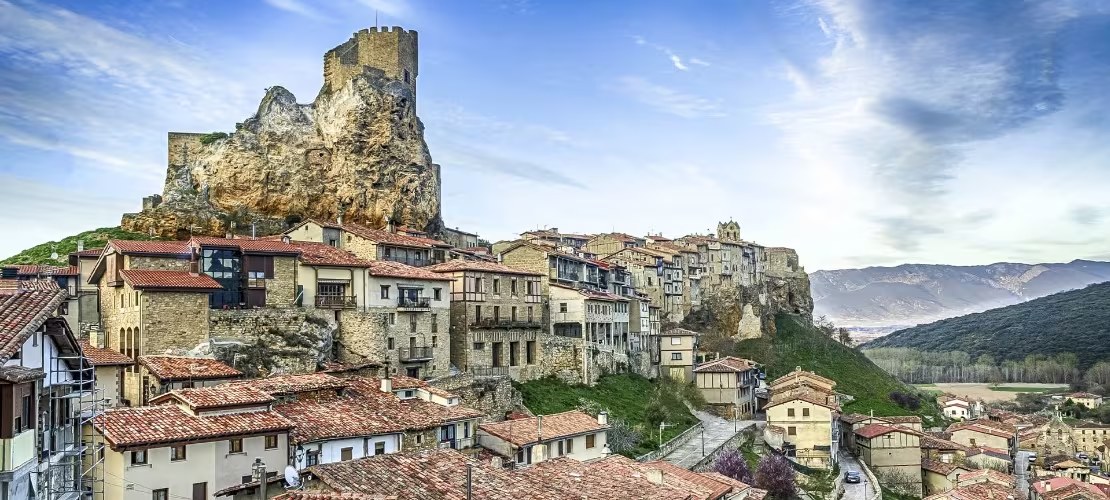 Frias, Image source: spain.info | Valencia There is evidence, from excavations in the Utiel-Requena area, that 2700 years ago people were already producing wine here. The Iberians learned the art of making wine from the Phoenicians (from around 800 BCE) and the Greeks (from around 600 BCE), who also introduced new grape varieties.  Image source: vineyards.com Valencia appellations: Alicante, Catella, Cava, El Terrerazo, Los Balagueses, Utiel-Requena, Valencia (with four sub-zones – Alto Turia, Clariano, Moscatel and Valentino). Grapes: Red: Bobal, Cabernet Sauvignon, Carignan, Garnacha, Merlot, Monastrell [aka Mourvèdre], Pinot noir, Tempranillo… White: Cava, Chardonnay, Macabeo. Merseguera, Moscatel de Alejandria, Sauvignon blanc, Sémillon…  Image source: comunitatvalenciana.com |
Wines of Spain

Image source: emporiumnostrum.com
Forward to France – Italy – USA – Chile
Next ten largest – Argentina – Australia – China – Germany – India – New Zealand – Portugal – Romania – South Africa – Turkey


