Adieu, the final farewell, an exploration of death!

BeliefsRituals: Forward to Conclusions - Back to Soul and Afterlife
Back to: Burials – Cemeteries - Religions – Death
Back to Adieu Index - Back to Bob Denton home page
–
Quick Links:
We have explored the world’s religions, and explored the world’s cemeteries but there are still facets of death beliefs and rituals that stop you in your tracks. Let’s look at some of these:
Parading the dead – India

Varanasi is a maze of a city on the shore of the river Ganges. It is one of the oldest continually inhabited cities in the world, and the holiest of the seven sacred cities in Hinduism.

The body is paraded through the crowded streets to the ghats. It is dressed in bright colours that highlight the virtues of the deceased – red for purity, yellow for knowledge… At the ghat the bodies are sprinkled with water from the Ganges River and then cremated.
It is believed that if one is cremated in Varanasi, and the ashes are released into the sacred and purifying water of the Ganges, then their reincarnation cycle will end and they reach Nirvana.
Walking the dead – Indonesia
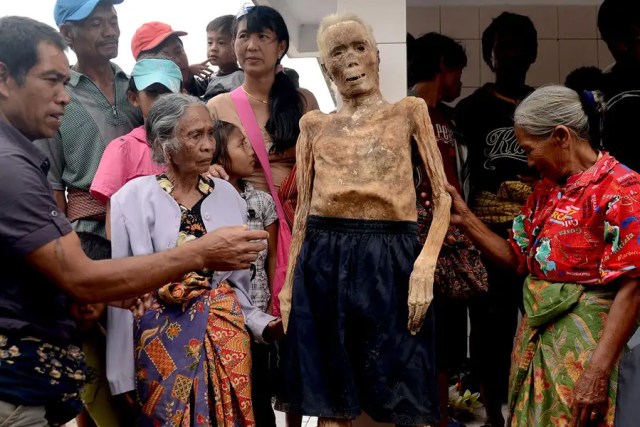
In Sulawesi Indonesia, the parade to the grave site is important. The body is placed in a palanquin and proudly marched through the streets. The people wish to touch the corpse and sometimes get so enthusiastic that the corpse is actually pushed from the palanquin.

But the Torajan practice of ‘walking the dead’ is an annual ritual each August. The body is exhumed, then washed and dressed, often in a change of clothing. This Ma’Nene ritual keeps the deceased relevant to their community. They then, often parade the corpses or carry them on chairs. Relatives buy cigarettes or accessories that they then give to their dead relatives. This ceemony attracts friends and families from afar, so that it enables different generations and new members of the family to get to know each other.
Elaborate coffins – Ghana

In the Greater Accra Region of Ghana, the practice has become to have an Abebuu adekai, or fantasy coffin. These are imaginative, yet functional, burial coffins made in local specialised workshops.

–
Green funerals – UK and elsewhere in the West
With all the focus on conservation and saving the ecology, it has become popular to have green funerals in the West. These use no embalming, chemicals, or environmentally-harmful processes. Biodegradable caskets are used to bury or cremate – which has the added benefit that it is less expensive than a traditional coffin.
Many are also dispensing with any funeral service.

–
Columbarium – Japan

In Japanese urban aresa where land space is very limited, they use columbaria with small multi-storeyed slots, utilising vertical space, for stacking cremation urns. This permits relatives to select a local site rather than needing to use a distant cemetery.
Some now automate the columbarium. Each relative is provided with a card bearing their urn information. The card reader instructs a computer to use an automatic ‘crane’ that retrieves the urn box and moves it to a worship booth. Other than the card, face authentification is available.

Still others, as in the picture, use a more hi-tech approach. The inventive Ruriden columbarium is operated by the Koukokuji Buddhist temple. It houses 2,046 futuristic altars with crystal Buddha statues, illuminated by LEDs, and each corresponds with drawers storing the ashes of the deceased.
–
Death Beads – South Korea
South Korea also has a shortage of space for graveyards. A law was passed in the year 2000 requiring families to remove the bodies of their dead from their graves after 60 years.
As part of this new approach, relatives are eschewing a decorative urn to hold their loved one’s ashes, and instead are turning the ashes of their deceased into beautiful beads. These are not considered as gemstones and are not typically worn but instead displayed in containers, usually made of glass, or set within dishes. The deceased one is kept close at hand and their memory honoured.
The process of making beads from cremated remains costs about nine hundred dollars.

–
Eating the dead – Amazon valley
The Yanomami tribe, based in Venezuala and parts of Brazil, has a unique approach for respecting their dead. When a tribe member dies, they are cremated and then the ashes become an ingredient in a local delicacy, a banana soup – and then it is consumed by members of the tribe. They believe this is the only way to honour the deceased and for the soul to achieve eternal peace. This is termed as endocannabilism.

–
Sky burial – Tibet
The practics of bya gtor, literally meaning bird-scattered, is a funeral practice in which the corpse is placed on a mountaintop to decompose while exposed to the elements and eaten by scavenging animals, especially carrion birds like vultures and corvids. This process is said to symbolise the liberation of the soul from the physical body.
The deceased’s family members will choose a lucky day. On the day before that, the family members take off the clothes of the dead and place the corpse into a foetal, sitting position, with the head against the knees. At dawn on the lucky day, the rogyapas or body carrier is summoned to take the corpse to the celestial burial platform among the mountains and remote from residential areas. Then su smoke is burned to attract the birds, Lamas chant sutras to redeem the sins of the soul.
The rogyapas deals with the body by dissecting it with blades. When the flesh is gone the bones are crushed and fed to the vultures. They do this while maintaining a cheerful manner, because Tibetan Buddhists believe that a light-hearted atmosphere can help guide the dead to transcend from darkness into their next life. Tibetans believe that if the vultures do come and eat the body, then it means that the deceased has no sin and that his or her soul has gone peacefully on to Paradise.

–
Space burials – USA and the West
First practised in 1997, by the US company Celestis, several famous celebrities and icons have paid to have their ashes spread into space. These have included astronauts and the creator of the TV and mivie series Star Trek. Other companies have followed its example.

A less-expensive approach, for non-celebs, is to use a firework rocket.

–
Hanging coffins – China, Indonesia, and the Philippines:
In China various ethnic minorities practice hanging coffins. The Bo people of Sichuan and the Ku people of Yunnan are good examples. Carved coffins of various shapes are fashioned from one whole piece of wood. These coffins either lie on beams projecting from the vertical cliff faces, or are placed in caves, or sit upon natural rock projections on mountain faces. The reasons for the practices is unknown, because no Bo people are left. But it is thought that it was simply to prevent the dead from being disturbed. Marco Polo commented on the practice and assumed that was its motivation.
Other peoples in other parts of China followed the practice too.

–
In the Philipines it is the Kankanaey people of Sagada from the island Luzon that has the practice of hanging coffins. The coffins are placed beneath natural overhangs, or on natural rock shelves or on projecting beams slotted into holes dug into the cliff-side.
The coffins are small because the bodies inside the coffins are in a foetal position. This is due to the belief that people should leave the world in the way they entered it. The coffins are usually carved by their eventual occupants during their lifetimes.
It is believed that this practice was reserved for the few, those who had performed acts of merit, or made wise decisions, or that had led led traditional rituals during their lifetimes. The more common burial custom of the Kankanaey is for coffins to be tucked into crevices or stacked on top of each other inside limestone caves. Like in hanging coffins, the location depends on the status of the deceased as well as the cause of death. All of these burial customs require specific pre-interment rituals known as the sangadil.
The Kankanaey believe that interring the dead in caves or cliffs ensures that their spirits (or anito) can roam around and continue to protect the living.

–
In Indonesia, liang tokek, literally ‘hanging burial’, is a funerary practice for the Toraja people of Sulawesi, either for primary or secondary burials. They use boat-shaped coffins, or erong, and place these below overhanging parts of the cliff-face. These can be natural overhangs or cave openings. Some coffins are placed beneath man-made overhangs.
They are guarded by carved wooden representations of the dead known as tau-tau. Older tau-tau are reasonably abstract, more modern tau-tau are more realistic. They are used to discourage looters from stealing items interred with the dead.
Liang tokek were reserved for the ‘founders’ of the village and thus have proved to be among the oldest dated coffins, c780 CE. The locations are believed by Torajans to be home to the spirits of the dead.
The more common types of ancient burial were the liang sillik and liang erong which were cave burials. The liang pak are tombs carved into walls, tangdan are house-shaped tombs for noblemen, usually placed on hilltops, and liang patane are house-shaped tombs for commoners.

–
Tower of Silence – Iran
This is a circular, raised structure built by Zoroastrians for excarnation (exposure of human corpses to the elements for decomposition). They are used in order to avoid contamination of the earth, water, or fire, all three of which are considered sacred in the Zoroastrian religion.
Carrion birds and other scavengers consume the flesh. Skeletal remains are gathered into a central pit where further weathering and continued breakdown occurs.
Zoroastrians consider human cadavers, animal carcasses, plus things like cut hair and nail parings are nasu, that is unclean and polluting.

Modern-day towers are fairly uniform in their approach, with an almost flat roof that has its perimeter slightly higher than the centre. The roof has three concentric rings: the bodies of men are in the outer ring, women in the second, and children in the innermost ring. The ritual precinct may only be entered by a special class of pallbearers, called nusessalars.

In Iran the towers were often built on top of a hill.
–
Reef memorials, Florida
An alternative is to become part of a coral reef. Neptune Memorials arrange to have a loved one’s ashes deposited as part of the living reef off the coast of Florida.

–
Famadihana – Turning of the bones – Madagascar
Famadihana is a funerary tradition of the Malagasy people in Madagascar. During this ceremony, known as the turning of the bones, people take the bodies of their ancestors out of their family crypts. They rewrap the corpses in fresh cloth, and write their names on the new cloth so they will always be remembered.

Then they dance to live music while carrying the corpses over their heads processing around the tomb before they return the corpses into the family tomb. They believe in celebrating the life lived by the dead person. It is thought that this practice has only been followed. in its present form, since the 17th c.

The practice has become less popular since being linked with pneumonic plague outbreaks in the region.
Boat to the Afterlife – Egypt
During ancient times, the Egyptians used to bury a barge, dedicated to the sun god Ra, close to the Pharaohs’ tombs to help with their transportation in the afterlife.

One of the most well known examples of this is the Khufu ship, which was built and then buried at Giza, along with the rest of the items he would take with him to the afterlife. The ship was originally displayed in the specially-built Giza Solar boat museum, but was later moved to the Grand Egyptian Museum.

–
Viking funerals – Scandinavia
Norse traditions had a Viking ‘desptach’ to the afterlife as a key part of its culture. The average Viking was cremated, but noted Viking fighters were afforded the ultimate honour of being cremated with their boat. The longboat was filled with food, alcohol, and other tributes, then set on fire and launched.

–
BeliefsRituals: Forward to Conclusions - Back to Soul and Afterlife
Back to: Burials – Cemeteries - Religions – Death
Back to Adieu Index - Back to Bob Denton home page


