
Forward to 1789, Geneva CH – Products of Industry Exhibition – Forward to next London entry
Back to Getting Noticed
RSA Exhibitions, London UK – 1760 and 1761
My personal favourite for the title of ‘first formal exhibition’ was the series of events held by the ‘Society for the Encouragement of Arts, Manufactures and Commerce’. It was also where the concept of showing Fine Art besides Objects of Manufacture and Industry was first questioned. So in our Anglo-French competition, London was first!
In 1753, William Shipley, a little-known drawing master in Northampton, developed the idea of stimulating industry by means of prizes funded by public-spirited people. Through mutual friends in London he was introduced to the Rev Dr Stephen Hales FRS, a distinguished scientist. Hales specialised in plant and animal physiology, particularly in the areas of blood pressure measurement and the study of air and water’s role in living organisms. Hales liked Shipley’s idea and asked him to put his proposals in writing while Hales contacted two important colleagues, Viscount Folkestone and Lord Romney, to seek their assistance.
They jointly developed a proposal for a fund to support improvements in the liberal arts, sciences and manufactures, with revenues raised through subscription from influential political and social groups. The subscription was set at two guineas per annum, or a lifetime membership for £20 (this at a time when average income was £14 pa).
Their declared aim was to ’embolden enterprise, enlarge science, refine art, improve our manufacturers and extend our commerce’.

at Rawthmell’s Coffee House, 22 March 1754
Anna Katrina Zinkeisen
On 22 Mar-1754 they formally founded the Society for the Encouragement of Arts, Manufactures and Commerce (SEAMC). This first meeting (of nobles, clergy, gentlemen and merchants) was held at Rawthmell’s Coffee House, 25 Henrietta Street, Covent Garden, London. Seventeenth and eighteenth-century coffee houses in England were effectively the talking shops and exhibition venues of their time, those attending routinely explored new ideas, processes and devices.
At that first meeting Viscount Folkestone was elected as the first SEAMC President, Hales would be its Vice-President, Lord Romney would become the second President, serving for thirty years, Henry Baker FRS had founded the Universal Spectator and Weekly Journal (with Daniel Defoe). Others present included Shipley of course, with Gustavus Brander (naturalist); Nicholas Crisp (merchant), John Goodchild (linen draper and society treasurer), Charles Lawrence, Husband Messiter (physician) and James Short (inventor/telescopes)

It was granted a Royal Charter in 1847, and granted the use of the term ‘Royal’ by Edward VII in 1908, when it became the Royal Society for the Encouragement of Arts, Manufactures and Commerce, though most often referenced as the RSA.
The 1754 first meeting
Two centuries later the 1954 painting above, by Anna Katrina Zinkeisen (1901-1976), presents their first meeting this features five members whose portraits are identifiable:
At the far end of the table: Rev Dr Stephen Hales FRS (1677-1761) Hales was an English clergyman who made major contributions in a broad range of scientific fields including botany, pneumatic chemistry and physiology. He would become vice president. | Standing, rear of the table: Henry Baker FRS (1698-1774) Baker was associated with Daniel Defoe in starting the Universal Spectator and Weekly Journal in 1728, intended as an essay-sheet rather than a newspaper. It ran until 1746, and 907 issues. Baker was a naturalist. | Standing, rear of the table: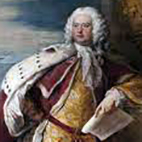 Viscount Folkestone (1694-1761) Born, Jacob des Bouverie, the Huguenot descendant, Folkestone, became MP for Salisbury. He was ennobled in 1747 and was elected in 1755 to be the first SEAMC President, until his death. |
Sat at the far side, centre: Lord Romney (1712-1794) Born Robert Marsham, he was a founding member and became the second SEAMC President in 1761, serving for thirty years. | Sat at the far side, centre: William Shipley (1715-1803) English drawing master, social reformer, inventor and the instigator of the RSA. |
Others who were present at this first meeting:
Gustavus Brander (naturalist); Nicholas Crisp (merchant), John Goodchild (linen draper and society treasurer), Charles Lawrence, Husband Messiter (physician) and James Short (inventor/telescopes)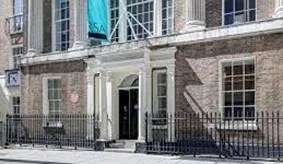
RSA offices
In 1774 the RSA moved to nearby John Adam Street, which became its headquarters,
its façade states ‘Arts and Commerce Promoted’.
In 2015 the modern RSA, decided to create a version of the coffee house as a space for RSA members to pause for critical thought, at its John Adam Street premises.
Located in the coffee shop is a ten-part mural that provides a timeline of the RSA.
The first mural panel (of 10) which depicts the early members and cites their goals.
RSA’s original medal award
The mural also defines two of the first four RSA prizes issued:
– sourcing the best quantity of cobalt in Great Britain, imports were then running at £200,000
– raising and curing not less than twenty pounds of madder, this was for the local dyeing of textiles, wool, silk, cotton, to reduce the dependence on imported dyed goods.
Two further prizes at the first meeting were for:
– the best drawing by a child under 14 years of age (Edwin Landseer would later win this one)
– for the best drawing by a child between 14 and 17.
The society’s intention for these two prizes was to encourage a supply of draughtsmen,
especially for creating designs in the textile industry.
The RSA prohibited the grant of prizes for inventions that had been patented.
It is believed that the RSA first used the notion of medals and prizes, this would be fully adopted by The Great Exhibition in 1851.
First exhibition, 1760
For its exhibition, the Society first wrote to member companies to submit entries for assessment in 1756 and again in 1757 and later began to exhibit these.
It held its first contemporary art exhibition in 1760 at its Great Room, just 24m x 12m (80’ x 40’) situated in the Strand opposite Beaufort Street. It attracted sixty-nine participants that included Gainsborough and Reynolds, some 130 works on show.
It was open from 9:00–14:00 and ran for a fortnight. This attracted 69 entrants and 130 works, including those of Gainsborough and Reynolds. There was some dissent about its charging admission, but this was resolved by instead selling the catalogue for sixpence; some 6,582 catalogues were sold contributing a net £100. One estimate claimed there had been a total of 20,000 visitors.
The exhibition connected artists with a public that was newly affluent, urban, middle-class consumers that would be essential for the future, to replace the declining patronage of aristocrats.
However, the RSA gently commented that this 1760 public was not well-behaved, committing a number of incidents. For example, the Society’s porter, Morgan Morgan, was assaulted for gently nudging a visitor to make way for some ladies though Morgan promptly returned the blow.
As a result, the Society stated that for future exhibitions would give notice that ‘order must be kept’. The next year’s exhibition employed six constables for crowd control, and the person managing security was given the discretion to employ up to eight more if required. Despite the constables’ presence in 1761, the RSA reported dealing with many ‘tumults and disorders’, though within their capacity to control. However, in 1762 they had to compensate the venue’s landlady for a broken window.
Through the 1760s the RSA membership grew to over two thousand individuals, with annual subscriptions and other incomes exceeded £4,000.
Second exhibition, 1761 (9 May-6 Jun)
The next year, 1761, the RSA held a much more general exhibition in a rented warehouse adjacent to its headquarters, where they featured the award winners, who had submitted their notions and equipment to the RSA for their review. Medlas and cash premiums were awarded. This featured equipment that had won an award, with volunteer artisans in attendance to explain the exhibits. There were also lectures and demonstrations of new ideas and devices.
It ran for four weeks and was open between 07:00 – 13:00. This event focused on mechanical devices including model windmills, spinning wheels, a threshing machinem a crane and several model ships. From 1761 onwards the RSA purchased the machinery and inventions that had entered its competition and merited a prize, to act as a repository of innovation.
There were also lectures and demonstrations of new ideas and devices. A one shilling admission charge was proposed, any profits being earmarked for elderly or infirm artists.
Awards were given for innovation and excellence in Agriculture, Chemistry, Colonies and Trade, Manufacture, Mechanics and the Polite Arts (painting and plastic arts). Later RSA awards were as varied as spinning in workhouses, carpet making, tree-planting for timber…
The event had planned to include contemporary art, however, because visitor admission was chargeable, the artists refused to join the event. A membership split ensued when a group broke away to form the Society of Artists of Great Britain, subsequently becoming the Royal Academy [‘RA’], which later still (1769) began to run its own exhibitions.
[Note: I could find no visitor attendance figure] Despite the constables’ presence in 1761, the RSA reported dealing with many ‘tumults and disorders’, though within their capacity to control. However in 1762 they had to compensate the venue’s landlady for a broken window.
Later developments
Following the membership split, the RSA focused on production techniques and the RA on fine art.
In 1763, the various RSA committees offered 375 cash awards, for a total value of more than £18,000, along with 64 gold and silver medals.
By 1764 the organisation for handling prize entries and awards had become huge, the offers published that year filled ninety-one pages of text and comprised 380 classes in which entrants might compete. By 1766 the amount expended on premiums totalled £16,625 (equivalent of £3m today [CPI Calculator]).

(illustration – Knight’s London 1843)
From 1843-1861 Prince Albert served as the RSA President.
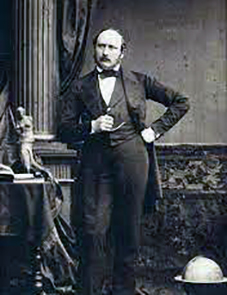
Notable past fellows include Charles Dickens, Benjamin Franklin, William Hogarth, Samuel Johnson, Adam Smith, Karl Marx, Nelson Mandela, David Attenborough, Stephen Hawking and Tim Berners-Lee
Today’s RSA (Royal Society for the Encouragement of Arts, Manufactures and Commerce) still seeks to enrich society through ideas and action, to create the conditions for enlightened thinking and collaborative action that addresses pressing social challenges.. It works through its Fellowship programme and via institutions and communities to build networks and offer opportunities for collaboration (source: www.thersa.org).
Forward to 1789, Geneva – Products of Industry Exhibition – Forward to next London entry
Back to Getting Noticed


