Adieu, the final farewell, an exploration of death!

SoulAfterlife: Forward to Anomalous Beliefs - Back to Famous Burials
Back to Adieu Index - Back to Bob Denton home page
–
Quick Links:
| Definition |
| Who invented writing? |
| Religious interpretations: |
| – Ancient civilisations |
| – Dharmic Religions |
| – Judaism |
| – Christianity |
| – Islam |
| Scientific interpretations: |
–
Definition:
Pretty much all the recognised religions and most philosophical theories suggest that we humans have souls as something that exists beyond our physical life. It is usually defined as something spiritual that encapsulates elements of that person’s personality and life experiences.
Most suggest that these souls do continue to exist after physical death, and many believe that they may be reincarnated. Reincarnation is a mainstream teaching in Hinduism, Sikhism, Buddhism and Jainism. But today, fewer than half of Indians in each of these groups say they actually believe in reincarnation – for example, only 40% of India’s Hindus say they believe in it.
Yet science has signally failed to provide any sort of evidence for a soul. Neuroscientists in fact suggest that everything previously attributed to the soul has now been discovered in the brain – there is nothing left over for the soul to ‘manage’.
–
But religion and philosophy still persist in believing in the soul. However, this fairly simple notion soon becomes very complicated.
Where precisely is the soul located? The ancients placed it in the lungs or the heart, Descartes (1596-1650) attributed it to the pineal gland, more recent beliefs usually place it in the brain. Some argue that quantum physics opines that a spacetime anomaly allows for consciousness where there is no physical body. But this too has never been demonstrated.
Judaism and some Christians insist that only humans possess souls. Other philosophies and religions suggest that animals do also have them.
Aristotle in On the Soul, aka De Anima, (c350 BCE) said animals – and plants – had souls, but that only human souls were immortal. His treatise then ponders the nature of plant, animal and human souls concluding that the human version is more sophisticated because we have intellect- it is more rational.

Aristotle reviews his predecessors’ beliefs – these include Parmenides (b 515 BCE) who proposed the notion of there being a personal god and that the universe is one organic whole. Democritus (b 460 BCE) who described atomism, that all matter consisted of indivisible atoms, the building blocks of all things. Aristotle concluded that the very essence of any living thing is the soul. He argued that since the active principle in our mind acts with no bodily organ, it can exist without the body, and thus could survive death, but he insisted it was not in fact separable from the body. He suggests that the soul is not personal, that there is only soul and not souls, they are all part of one soul. Alexander of Aphrodisias (2nd-3rd c CE) suggested a disembodied soul should be attributable to God.
The French mathematician and philosopher Blaise Pascal argued that belief in the God of Christianity, and accordingly in the immortality of the soul, is justified on very practical and rational grounds. One who believes in the soul has everything to gain if he is proved right and nothing to lose if he is shown to be wrong. One who does not believe in the soul has everything to lose if he is wrong and nothing to gain if he is right. A religious ‘hedging’ of bets.
–
Who invented writing?
Significant in the ancient tale of the soul is the arrival of literacy. In ancient times when a form of literacy ‘arrived’ it was usually restricted to a tiny elite in those societies. There were rather more societies that who had n familiarity with a written language.
Today, the global literacy rate is around 85 percent. The other 15% is mostly aware of the existence of written language, possibly because they feel their exclusion from it. Mass literacy is all so recent, it dates from the 19th century, and has grown rapidly over the past 200 years.
 Sumerian proto-cuneiform – decipered by German scholars in 1837.  Evolving Chinese characters 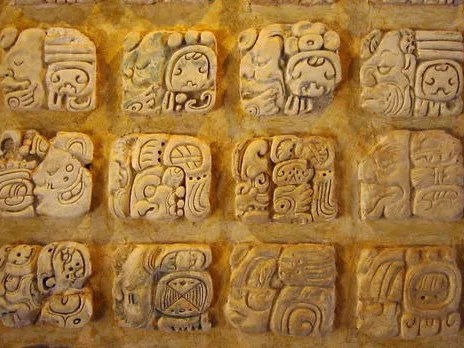 Mayan glyphs, deciphered by US and Russian scholars in the late 20th c. | It is usually said to have been invented, quite separately, at three distinct places and times: – Sumerian cuneiform, Mesopotamia (c3400 BCE) – Chinese characters in China (c1200 BCE) – Mayan glyphs in Mesoamerica (c300 BCE) But then it clearly also happened with:  Indus Valley script (c2600 BCE)  Linear B from Crete in Greece (c1450 BCE)  And, King Sejong of Joseon who took inspiration from the Chinese script to invent the Korean script in 1446 CE. |
| But we are interested in the Sumerian inspiration of the Ancient Egyptians. Who, having developed their script from 3250 BCE, used it to spread their beliefs widely. This was also true of their religious notions, these were spread throughout the Egyptian community. Egyptian hieroglyphs were first deciphered in 1822 with the help of the Rosetta stone. |  |
 | Egyptian hieroglyphs inspired the Phoenician abjad – also called Early Linear script – with 22 consonants. It in turn inspired many local scripts – Hebrew (10th c BCE) – Old Aramaic (10-9th BCE) – Moabite (9th c BCE) – Ammonite (9th c BCE) – Edomite (6th c BCE) – Sogdian (5th c BCE) – Syriac (c 500 CE) – Uighur (c 800 CE) – Mongolian (1200 CE). But it was its use by the Phoenicians that was most significant. Its mercantile merchants spread their writing throughout the early Mediterranean communities. |
| From the 9th c BCE, the Greek alphabet emerged, this was also inspired by the Phoenician. It was the first known alphabetic script to have distinct letters for vowels as well as consonants. By the end of the 4th century BC, this had been resolved into the Euclidean alphabet of 24 letters. Later, it developed the letter case, uppercase and lowercase, this happened in parallel with Latin during the modern era. The Greek alphabet today also serves as a source of symbols and labels in mathematics, science, and other fields. |  |
 | The Greek alphabet was the direct ancestor to the Latin script, that emerged in the 7th c BCE. The illustration is of the Duenos inscription, from the 6th c BCE, and depicts one of the earliest known forms of the Old Latin alphabet. Today, the Latin script is the most widely used alphabetic writing system in the world. It is the standard script of the English language usually simply referenced as ‘the alphabet’. |
| The Cyrillic script was developed from the Greek uncial, augmented by ligatures (letters joined together) and by letters from another alphabet. This was developed by the monk, Saint Cyril, in Medieval Bulgaria during the late 9th c CE. Between the 18th and 20th centuries it was replaced by the modern Cyrillic script, which is used for a number of Slavic languages – those that have experienced a high degree of Russian cultural influence. |  |
–
RELIGIOUS INTERPRETATIONS:
Having examined the hand-me-down nature of this progress of writing, is it much of a stretch to suggest that beliefs too tended to be passed down?
Let’s take a look at the background history of the soul:
–
Ancient civilisations
Zoroastrianism (from Persia) and Hinduism (from the Indus Valley aka Harrappan, civilisation) are claimed to have existed before Ancient Egypt. The first believing in one god, the latter in many. But back then it was clear which civilisation made the most impact.
Ancient Egyptians (3100-332 BCE) had their religion as a central tenet of their lives – and afterlives. They believed that an individual was made up of various elements, some physical and some spiritual. Having introduced writing their beliefs were spread widely, and this was true of their religious notions that were spread throughout the Egyptian community.
A number of Egyptian gods guided the souls of the dead through the afterlife. Many illustrated afterlife texts explained how the dead should be treated and how they should behave to complete that journey safely. These beliefs focused on an underworld (the Duat), that was reached via a passageway of statues (many of these of Horus), and led to Osiris. It was the god Osiris who assessed the virtue of the soul and granted those who ‘passed’ inspection a rebirth.

Dating back to the 16th c BCE, the Book of the Dead contained spells or magic formulas, and was placed in tombs to offer advice, protection and knowledge. It would aid the deceased’s journey through the netherworld. The book drew on numerous sources, editors and authors. Scribes copied these texts onto rolls of papyrus, usually colourfully illustrated, and then sold these on to individuals for use in burials.
Family and friends used the book’s advice to assist the deceased to achieve rebirth. The coffin and tomb bore some of these religious incantations and texts further to assist. These grew ever more complicated.
Egyptian polytheistic beliefs influenced Greek and Roman religions. Its empire also passed its beliefs to Canaanite and Babylonian culture.
–
Dharmic religions

The older Dharmic religions also believed in a soul.
Its nature was perhaps best defined in the Bhagavad Gita (Song of the Lord) (5th-2nd c BCE):
It is born not, nor does it ever die,
nor shall it, after having been brought into being, come not to be hereafter.
The unborn, the permanent, the eternal, the ancient, it is slain not when the body is slain.
–

The oldest collection of Sanskrit hymns is the Rig-Veda (1400 BCE), these were composed by the Aryan people who invaded the Indus Valley in about 1500 BCE. These early Vedic songs focused on funeral rites and defined the individual as having three separate entities:
- the body,
- the asu (life principle), and
- the manas (the seat of the mind, will, and emotions).
The asu and manas were not considered as oarts of the essential self, the soul. This facet of the person that they believed survived death, was something other. Often thought of as a kind of miniature of the living man or woman that resides within the the body, and near the heart.
–
It was the Upanishad texts (600-480 BCE), that added new dimensions and developed the central religious concepts of Hinduism. The samsara meaning rebirth, and karma, defined the cause and effects operating on an individual. These two facets are aspects of the atman, or self, the very essence of the person that contains the divine breath of life. The atman within the individual was defined as ‘smaller than a grain of rice’, but was connected to the Atman or Brahma, a divine principle, a great cosmic soul.
The atman is however subject to avidya, a profound ignorance that blinds the atman to the true nature of Brahma. Avidya creates maya the illusion that deceives each individual into mistaking the material world as real. This illusion forces the individual into accumulating karma and being subject to the process of samsara, the wheel of new lifetimes and deaths.
–
By the third century BCE Hinduism had largely combined this cyclical process of lives and rebirths with an afterlife system that sits between their lifetimes.

Moksha is the term for the various beliefs in emancipation, liberation, nirvana, or release from samsara.
Hindu cosmology depicts three lokas, or realms. These are Heaven, Earth, and a Netherworld. But to confuse this further there are fourteen additional levels within which degrees of suffering or bliss awaits the soul, while it is between physical existences.
–
Later beliefs considered the relationship between the individual and God. Those that prepared by adopting a loving attitude, who studied the scriptures, and devoted themselves to God could free themselves from samsara, the endless cycle of death and rebirth.

Eternal life was granted to those who, at the time of death, gave up their physical body and had only thoughts of God on their minds.
–

Reincarnation is a mainstream teaching in Hinduism, Sikhism, Buddhism and Jainism. But today, fewer than half of Indians in each of these groups say that they believe in reincarnation. For example, just 40% of India’s Hindus declare that they believe in it.
–
Judaism
Judaism derived from the Canaanite and Babylonian religions.
Early Hebrews believed that after death the soul descended to Sheol, a place deep within the Earth where the spirits of the dead were consigned to dust and gloom. By the time of the Book of Daniel (165 BCE), this belief had changed, instead suggesting that individuals could be resurrected to receive God’s judgement.

Only a few verses in Daniel mention an afterlife of the soul, it is nowhere else in their scripture. But it is widely discussed within Rabbinic literature, the Kabbalah, and in Jewish folklore. Here the belief is that after physical death, the soul returns to its spiritual origin. Some Jewish thinkers refer to the soul’s time on Earth as a period of exile to be served until its reunion with God.
–
Greek beliefs were subsumed by Judaism so that the soul is considered as the essential self that existed prior to their earthly body and which survives the body’s physical death. They came to believe that God would raise the dead to life again and pass judgment upon them (yom hadin). He would reward the righteous and punish the wicked. Resurrection was a restoration of persons who would again possess both physical bodies and spirits.

Those who have lived righteous lives and kept their faith in God pass into the paradise. Those who deserve punishment are sent to Gehenna, staying there for a period based on the seriousness of their sins.
–
Christianity
Christianity was very much formed from within Judaism, and so it shares the Jewish beliefs of the soul and the afterlife. That a reunion of body and soul will be accomplished in the next world.
Another key principle of Christianity is the resurrection of Jesus after his crucifixion and his promise of an afterlife for those who believe in him.

After Paul’s (aka Saul’s) change of heart on the road to Damascus, he was confronted by Greeks who were content with their own philosophy about life, death and soul. He found it necessary to modulate his, and Christianity’s, principles to distinguish between the living body and spiritual body. This then proved to be a better fit with Greek thought.
The early Christian church also developed its doctrine to become more compatible with Plato’s metaphysical beliefs, yet where the Greeks saw the soul coalescing with the Divine, Christianity believed that each individual had its own soul and afterlife.
This continued until the First Council of Constantinople in 543 CE formalised that each soul was individual, that it lived just once, died, and waited for the Day of Judgement when Christ would return to Earth. Both the Apostles’ Creed and the Nicene Creed suggests that the soul and the physical body will be resurrected on the Day of Judgement.

Of course, the early Christian Church believed that the Second Coming was imminent, that many who were alive, at the time of the apostles, would live to see his return.
Christians believe in a heaven as the dwelling place of God and his angelic entities that serve him faithfully. Those Christians that are redeemed, live with him forever in glory. The suggestion that there are many mansions in this kingdom implies that other faiths are welcome too.

Hell is the alternative, a place of torment for those dismissed at the Last Judgment. Usually envisaged as a pit filled with flames, these images inherited directly from Judaism’s Sheol and the Greek’s Hades.
The councils of Florence (1439) and Trent (1545–63) later added the notion of a purgatory, a holding area after death where souls can seek to be forgiven for certain of their sins. Their families and friends can also offer prayers that may assist those in purgatory, as they seek to gain forgiveness for earthly transgressions. Good reasons therefore to continue to continue to believe and regularly attend church!
–
Islamism
Islam also believes in the human being as a combination of body and spirit.

Muhammed (570-632 CE) regarded the soul as the essential self of a human being, but influenced by Judeo-Christian tradition, he suggested that the physical body was essential to life after death.
The soul is nafs, (similar to the Greek psyche,) and the word for the soul that elevates humans above the animals is ruh (similar to the Greek nous). These two aspects of the soul are the human and the divine.
Islam also suggests that how the individual’s life has been led determines either an afterlfe living in paradise or one of endless torment. Muhammed speaks of the Last Judgment, that the resurrection of the dead will bring bliss to the righteous, but torment to the wicked. In Islam no soul is able to assist a relative or friend, no soul can make intercession for another. This differs from Christianity in that the judgment is more of an individual matter.

The Islamic paradise is an extension of the legendary Garden of Eden in the Bible – a beautiful place filled with trees, flowers, and fruits, but it’s nature is considered ineffable.
The Quran says, ‘All who obey God and the Apostle are in the company of those on whom is the grace of God – of the Prophets who teach, the sincere lovers of Truth, the witnesses [martyrs] who testify, and the righteous who do good…’

The alternative, Hell is a place of fire and burning. In Islamic teaching, neither heaven nor hell will last for eternity, as infinity belongs only to Allah alone. This suggests there may exist various stages of paradise and hell.
–
SCIENTIFIC INTERPRETATIONS:
Missing 21 grammes
In the April 1907 issues of American Medicine and the American Society for Psychical Research, Dr Duncan Macdougall of the Dorchester Consumptives’ Home, near Boston Massachusetts, reported placing six dying patients on a bed fitted with a special balance. He concluded that at the moment of death there was a loss in weight of around three quarters of an ounce, or 21 grammes.

His paper entitled Hypothesis Concerning Soul Substance Together with Experimental Evidence of The Existence of Such Substance. He concluded that this was the soul leaving the body.
He did the same experiment with fifteen dying dogs (where did he get them?) but he found no commensurate loss in weight as they died. He was unsurprised because, of course, he believed that dogs did not have souls.
MacDougall’s first patient, a man, died on 10-Apr 1901, and the doctor recorded a sudden drop in the scale of 0.75 ounce (some 21.2 grammes). But MacDougall’s second patient lost only 0.5 of an ounce (14 grammes) and this did not happen until fifteen minutes after he breathed his last. The third case showed a two-step loss of 0.5 ounce at death and then one ounce (28.3 grammes) a minute later. His fourth was a woman dying of diabetes, and he dismissed this for his balance not having been properly calibrated. The fifth, lost 0.375 ounce (10.6 grammes), but the scale subsequently malfunctioned casting doubt on this. The sixth was dismissed because the patient died while MacDougall was still adjusting his scales.
Nonetheless the doctor published his findings based upon the first patient. He said the soul was tangible, it weighed twenty-one grammes! He even got coverage in the New York Times.
This experiment has never been repeated again. Science has not established whether the soul exists and, unsurprisingly, no determination of its weight has therefore been established.
–
The search for the soul
Whether MacDougall can be considered scientific is arguable. But science does not acknowledge a spiritual side to our physical life which makes the sould something of a non-starter.
Many scientists have suggested that everything deemed to be measurable about the soul can today be explained by our ever-improving understanding of the functions of the brain.
The religious adherents however view the soul as something more definite and absolute than any scientific theory or measurement. They say the soul is the essence of a person, it is immortal, transcendent, ineffable. As the hymn expresses it ‘Immortal, invisible, God only wise…’ Followers of religion place emphasis on their faith, defined as a strong belief in the doctrines of that religion, and based upon spiritual conviction rather than proof.

Clearly there is a mystery surrounding the specific events of conception and birth and of death, the processes of mental activity like memory and imagination prove perplexing, and our dreams parade inexplicable events and motives. Just why we appear to live in a subjective experience remains curious. These unresolved questions conspire to support the suggestion that there might be some ‘guiding hand’ or other form of external influence.
Biocentrism cretes another issue. It is the ethical view that equal value should be afforded to all living things. It suggests that human life is no more valuable than any other living organism’s, and thus all living things should be given equal priority. (MacDougall, above, certainly did not.) So doi animals and plants have souls?
–
I guess, if the soul is a matter of faith, then it is also becomes a matter of choice. If you choose to believe in a soul, then your faith will make that belief unshakeable. But, if you don’t so choose, then a faith will not be powerful enough to sway you.
–
SoulAfterlife: Forward to Anomalous Beliefs - Back to Famous Burials
Back to Adieu Index - Back to Bob Denton home page


