Adieu, the final farewell, an exploration of death!

Cemeteries: Forward to Famous Burials - Back to Other faiths
Back to Next tier of religions – Religions – Death
Back to Adieu Index - Back to Bob Denton home page
–
We have assembled twenty of the most interesting cemeteries that provide some insight to burial practices around the world. Then, gathered another forty as ‘other notable’ cemeteries.
Quick Links:
–
Highgate Cemetery, north London, UK

In the early nineteenth century the population of London was growing rapidly, from 1 million in 1800 to 2 million in 1840. Quite what to do with the commensurate increase in those dying became an issue, particularly when cholera and typhoid regularly struck the city.
Highgate was one of the solutions that emerged, it was created by The London Cemetery Company as a prestigious location that provided a calm and dignified setting to lure people away from their local churchyards.
It was one of seven cemeteries, the ‘Magnificent Seven’ necropolises, created around the then periphery of London to relive the pressure on the traditional churchyards. The first was at Kensal Green in 1833 with 65,000 graves today, then West Norwood in 1837 with 200,000 graves and 65 listed monuments. The others were Abney Park in 1840 which holds 200,000 people (it specialised in Dissenters), Nunhead in 1840 holding 270,000, Tower Hamlets in 1841 holds 350,000 and Brompton in 1852 that holds 205,000 people and 35,000 memorials.
The West was opened in May 1839 at the beginning of Queen Victoria’s reign. Dedicated to St James, it was two cemeteries, the East and the West, either side of Swains Lane in The Borough of Camden. It had fifteen aces (6 ha) that were consecrated for burials and another two acres used for dissenters. It soon became a fashionable place to be interred.
In 1854 a further nineteen acres (8 ha) were acquired to become the East cemetery. This was opened in 1850.
Victorians soon populated it with Gothic buildings and Gothic tombs.

Today it is owned and maintained by a charitable trust, the Friends of Highgate Cemetery Trust, which was set up in 1975 and acquired the freehold of both East and West Cemeteries by 1981.
Highgate has 53,000 graves holding 170,000 people. Its dramatic architecture has made it a Grade I listed historic park and garden, and its woods, shrubs and wildflowers meant that it also became a nature reserve.

The West cemetery has Grade I listed buildings on the Egyptian Avenue and the Circle of Lebanon; the latter had been presided over by a 280-year-old Cedar of Lebanon, sady felled in 2019.
Here you can see the graves of author Dame Beryl Bainbridge, the younger brother and elder sister of Charles – Alfred and Fanny Dickens, painter Lucien Freud, Nobel Laureate John Galsaorthy (cremated) and watercolourist William Heny Hunt.
Also here is the murdered Alexander Litvinenko, singer George Michael, model Elizabeth Siddal (the subject of Millais’ Ophelia), actor Patrick Wymark… In the dissenters’ area is physicist Michael Faraday.

The East Cemetery features the rather famous Karl Marx tomb which is Grade I listed, and Fireman’s corner erected by families of the London Fire Brigade in 1934, there are 97 firemen buried here.
Here you can see the graves of author Douglas Adams (Hitchhiker’s Guide…), TV presenter Jeremy Beadle, novelist George Eliot (her real name Mary Ann Evans – the name on the grave is Mary Ann Cross), co-founder of Foyles, William Foyle, actor Roger Lloyd-Pack (Only Fools and Horses and The Vicar of Dibley), Malcolm McLaren (manager of the Sex Pistols), sculptor Henry Moore (in the Moore family grave), actor Corin Redgrave, Bruce Reynolds (1963 Great Train Robber), actor Ralph Richardson, comedian Max Wall…
Highgate also has war graves, 259 from WW1 and 59 from WWII.
–
Père Lachaise, Paris, France – most visited!

This is the largest cemetery in Paris, its 110 acres (44ha) and it attracts 3.5 million visitors each year. It was the first municipal cemetery in the city and its first garden cemetery. Today, it is has become the most visited necropolis in the world.
It opened in 1804 and is named after the confessor to king Louis XIV. It was however founded by Napoleon, three days after he was declared Emperor. He said of the cemetery, ‘Every citizen has the right to be buried regardless of race or religion’. As a result, the cemetery has Jewish and Muslim enclosures.
This was part of a series of initiatives as the city graveyards of Paris reached capacity. Four new cemeteries were created Père Lachaise in the east. Montmartre in the north. Montparnasse in the south and Passy near the centre.

| FACTOID: The Catacombs of Paris are underground ossuaries containing the bones of six million people. The ossuary was created as part of the effort to eliminate the city’s overflowing cemeteries. From 1786 there were nightly processions of covered wagons to transfer the remains from most of Paris’s cemeteries into a mine shaft opened near the Rue de la Tombe-Issoire.  The remains came from the Saint-Innocents (the largest with more than two million bodies, Saint-Étienne-des-Grès (one of the oldest), Madeleine Cemetery, Errancis Cemetery (which had been used for victims of the French Revolution), and Notre-Dame-des-Blancs-Manteaux. The remains include the assassin of Jean-Paul Marat – Charlotte Corday, and the mistress of Louis XV – Madame du Barry, the chemist Antoine-Laurent de Lavoisier, lawyer and statesman Maximilien Robespierre… Today this has an access from the Place Denfert-Rochereau as a location for private events and concerts. One can visit the Catacombs and Ossuary, but a sign reads, Arrête! C’est ici l’empire de la Mort’ – ‘Stop! This is the empire of Death’. |
At first Père Lachaise was considered too far from the city and attracted few burials. The graveyard initiated promotional initiatives, as for example by moving actor and playwright Molière to this new resting place.
These initiatives worked as the city grew and the cemetery had to be extended in 1824, 1829, 1832, 1842 and 1850. Today, some suggest that more than a million bodies, plus the ashes of many others are here.

Notable people buried here are many – actress Sarah Bernhardt, composer Georges Bizet, composer and pianist Frédéric Chopin, author Sidonie-Gabrielle Colette, actress Dame Olivia de Havilland, mime artist and actor Marcel Marceau, poet and singer-songwriter Jim Morrison, singer Édith Piaf, essayist and novelist Marcel Proust, novelist, poet, playwright, and art collector Gertrude Stein, grammatist, poet and wit Oscar Wilde…

There is a place in the cemetery called the Communards’ Wall, where, in 1871, remembering the 147 Paris Commune participants that were shot and buried in common graves.

In 1899, the Monument aux Morts by Albert Bartholomé, a memorial to unidentified deceased Parisians, was erected in Père Lachaise. The monument holds a communal ossuary.

There is a rule that says to be buried in Père Lachaise, the individual must die in Paris or have lived there. Even if you fulfil these requirements there is today a waiting list for plots. This means that plots are let for only thirty years, if the relatives do not renew the remains can be removed.
–
El Cementerio de la Recoleta, Buenos Aires, Argentina
Established in 1822, this is named as one of the best cemeteries in the world by the BBC and was placed in the top ten of CNN’s most beautiful cemeteries in the world.

It has a 14-acre site (5.5 ha) and has 4,691 vaults, ninety-four have been declared as National Historical Monuments of Argentine.

Franciscan Recollect monks were identified by their grey habits and pointed hoods, their vows of poverty and a life devoted to prayer, penance and spiritual reflection. This is a French order that often operated as missionaries, notably in early Canada. They arrived in Argentina in the early eighteenth century but disbanded in 1822. The site of their convent was converted into the Northern Cemetery, which later became known for the monks and the area of BA in which it is located.

The cemetery is designed like a city with wide tree-lined avenues, It sits inside high brick walls and its neo-classical gate is supported by tall Doric columns.

It contains elaborate marble mausoleums, decorated with statues, and using material imported from Paris and Milan. The mausoleums are both designed and built by notable sculptors working in the style of Art Deco, Art Nouveau, Baroque, and Neo-Gothic.
It contains notable people, of foremost interest is actress and politician Eva Perón (née Duarte).

The embalmed corpse of Eva Perón was originally buried here after she died in 1952. But when her husband Juan Perón was overthrown by a coup in 1955, members of the new regime seized the remains, most assumed, as part of their drive to erase Peronism – though they claimed it was for the security of her corpse. In 1957 the Vatican had the corpse transported to a Milan cemetery and buried it under a false name.
In 1970 a Peronist group killed the former president Aramburu because they believed he had managed the team that had seized her body. She was disinterred and moved to Spain, and presented to Juan Perón where he lived in Milan with his third wife, Isabel. By 1973 Perón had moved back to Argentina where was re-elected as president, and Isabel as vice-president. When he died in 1975 Isabel became president and engineered the return from Spain of Evita’s body, where her body was restored carefully.

Isabel planned a national monument that would hold both Juan and Evita, but she was deposed in 1976. Evita was placed in the Duarte family mausoleum in October 1976. She is buried five metres down in a fortified crypt at La Recoleta, this was some tweny years after her body had been seized.
The cemetery features artists, writers, scientists, presidents of Argentina, Nobel laureates, and key players in the Argentine military.

The Neo-Gothic tomb of Liliana Crociati de Szaszak, was made to her mother’s unusual design. Liliana had died when an avalanche hit her hotel in Austria at just 26-years-old. The tomb has a statue of Liliana in her wedding dress, with her hand resting on a later-addition statue of her dog, Sabú. Her father penned a particularly poignant poem that is displayed on a dais forming part of the tomb:
| Only I ask myself why You left and left my heart destroyed That wanted only you, why? Why? Only destiny knows the reason, and I ask myself why? Because we can’t be without you, why? You were so beautiful that invidious nature destroyed you. Why? I only ask myself why, if God exists, does he take away that which is not His. Because He destroys us and leaves us to an eternity of sadness! Why? I believe in fate and not in you. Why? Because I only know that I always dream with you, why is that? For all the love my heart feels for you. Why? Why? Your Papá |

When we visited the cemetery, much was made of the folk singers who would sing for you beneath a big tree at the gate. But I cannot find any mention of this on the Net today, it prefers to talk of its many cats and the tales of its ghosts.

–
Wadi us-Salaam cemetery, Najaf, Iraq – the largest!
This Islamic cemetery is the world’s largest graveyard at 1,500 acres (600ha).

It is in the holy city of Najaf, and its name means ‘Valley of Peace’. Burials have been taking place in the cemetery for more than 1400 years, spanning both the Parthian (247 BCE to 224 CE) and Sassanid (224 CE to 651) periods.

It contains more than six million bodies and attracts millions of pilgrims annually. It is located near the shrine to the fourth Sunni Caliph, Ali ibn Abi Talib, aka ‘the prince of faithfuls’. Also nearby are shrines to the prophets Adam and Noah. Many suggest that that the prophets Hud and Salih are buried here.
Shi’ites suggest it was Abraham who bought land here. Though of course he is buried at the tomb of the patriarchs in Hebron, together with Sarah, Isaac, Rebecca, Jacob and Leah. Ali ibn Abi Talib suggested that Wadi Al-Salaam was a part of heaven. Shias believe that Ali has the power to intercede for the deceased, to lessen their suffering. Hence many of the Iraqi diaspora specify in their wills that they should be buried here.

Shi’ites are encouraged by religious edicts to bury their dead at this location through its more permissive attitude with regard to the commemoration of the dead and the erection of mausoleums. As a result, some 50,000 people are buried here every single year. Its ‘residents’ include kings, princes, sultans, prophets (Hud and Saleh, mentioned in the Quran) and scientists. But plots are running out.
Wadi Al-Salaam cemetery permits several kinds of burial, which were in low graves, and high graves using towers. There are also special rooms allocated to families that permit burial inside vaults, and in rooms carved underground and accessed by ladder.
–
Cradle of Mankind, Johannesburg, South Africa – the oldest!
This is a paleoanthropological site some 30 miles (50 Kms) northwest of Jo’burg. It is a UNESCO World Heritage Site which has the name ‘Fossil Hominid Sites of South Africa’.

The region was heavily mined for calcium carbonate. In 1947 the Sterkfontein Caves were discovered as the site of a 2.3-million-year-old fossil Australopithecus africanus.
This and other finds led to the area being called ‘The Cradle of Humankind’ as it has yielded a large number of small-brained hominin fossils, some dating to 3.5 million years ago.

Hominids may have lived throughout Africa, but it is the dolomitic caves here coated the remains in limestone and other sediments to preserve them. It therefore can be claimed as the oldest cemetery.
–
Old Jewish Cemetery, Prague, Czechia
This cemetery was started in the 15th c (the oldest tombstone is from 1439) and used until 1787, when a decree of Joseph II forbade burial places inside the inhabited parts of the town.

There are more than 12,000 tombstones in this cemetery, yet there are many more remains buried here. Jewish custom does not allow prior funerals to be superceded. The plot was small, so more and more layers of new earth were deposited into the cemetery, until it reached twelve layers. Many tombstones fell into the lower layers, and wooden coffins became destroyed over time. In many places piles of stone tombstones from different centuries can be seen sitting next to each other.

In later centuries plastic symbols and emblems for families, names, statuses and occupations begin to appear on what had previously been simple tombstones. Some created quadrilateral tumba (small houses), Prague is the only place in Europe with so many of these preserved.

Many tombstones contain symbols from Jewish tradition, a bunch of grapes is the symbol of fertility and wisdom, a moneybox symbolises charity, blessing hands for the descendants of priests, symbols of animals for personal or family names, reliefs of tools to symbolize occupations like scissors for tailors, mortars for pharmacist, violins for musicians – and the hexagram star of David.

The most important person buried here is Rabbi Löw (died 1609), associated with the legend of an artificial creature – the golem.

A number of trees grow within the cemetery.
–
Capuchin Crypts in Rome and Palermo Sicily

The Capuchin Crypt in Rome sits beneath the church of Santa Maria della Concezione dei Cappuccini on the Via Veneto, near Piazza Barberini.

When the friars arrived at the church in 1631, they had over three hundred cartloads of deceased friars. Today, It contains the skeletons of 3,700 bodies thought to be Capuchin friars buried by their order. They were organised in the crypt and the soil there was brought from Jerusalem by the order of Pope Urban VII. After decomposing for thirty years in that soil they were exhumed and arranged in the decorative arrangements.
The order insists their display is not meant to be macabre, but a reminder of the speedy passage of life, and to remind any observer of their mortality.
There are rooms each with a theme. They are lined with bones, even the light fittings. Decomposing monks, still in their habits, have been tied to the walls with their hands arranged in prayer.

The Crypt of the Resurrection uses bones from the dead friars to create a picture of Jesus raising Lazarus. There are: a Crypt of the Skulls; a Crypt of the Pelvises; a Crypt of the Leg and Thigh Bones; the Crypt of the Three Skeletons, the central skeleton holds scales and a scythe and a placard states:
‘What you are now we used to be; what we are now you will be…’.
These were visited by the Marquis de Sade who wrote of it, ‘I have never seen anything more striking.’ Mark Twain visited and wrote in The Innocents Abroad, ‘The reflection that [the Capuchian friar] must someday be taken apart like an engine or a clock…and worked up into arches and pyramids and hideous frescoes…’

A similar Catacombe dei Cappucini is in Palermo, Sicily. Bodies were added from 1599 to 1871.
Today, it displays some 8,000 decomposing bodies of the local elite, attired in their Sunday best, hung from hooks in the wall or displayed in their coffins.
The Capuchin monastery in Palermo had outgrown its cemetery in the 16th century and monks began to excavate crypts below it. Initially the catacombs were intended only for deceased friars.
In 1599 they mummified one of their number and placed him in the catacombs. Bodies were dehydrated and later washed with vinegar. Some bodies were embalmed, others were placed in sealed glass cabinets. Friars were preserved with their everyday clothing and sometimes with the ropes they had worn in penance.

However, it later became a status symbol to be entombed in the Capuchin catacombs. Locals would ask to be placed there dressed in certain clothes. Priests wore clerical vestments, while others were clothed according to contemporary fashion.
Each new body was placed in a temporary niche initially. So long as relatives’ contributions continued, the body would earn a more permanent slot. But if relatives stopped sending money, the body was set aside on a shelf until payments were resumed.
The catacombs were officially closed in 1880 but tourists continued to visit. The catacombs are open to the public. Photography inside is officially prohibited, that message is reinforced by prominent signage.

There are some 8,000 corpses and 1,252 mummies that line the walls. The mummies have been treated with one part glycerin, one part formalin saturated with both zinc salts, and one part of an alcohol solution saturated with salicylic acid.
The halls are divided into men, women, virgins, children, priests, monks, and professionals.
–
Inca and South American mummies

From 5,000 BCE the Chinchoros fishing tribe, who inhabited the north coast of today’s Chile, practiced mummification. Their process was to disassemble the corpses. They treated the internal organs to prevent decay, and reassembled the body. They frequently used wooden supports placed alongside the spine and limbs. They filled the body cavity with fibres and feathers, then coated the exterior of the body with clay, which they sculpted and painted.

From 4,000 BCE another coastal community, the Palomas, used salt to preserve bodies. They positioned the bodies in a foetal stance, sitting with knees up to the chest and hands clasped around them. The bodies were wrapped in reed matting and placed beneath the floor of their homes – thus preserving the force of the deceased in the domestic space.

Prior to the Incas, the Aymara people lived in today’s Bolivia and Peru. In the Chincha valley (4,000 metres [2.5 miles] above sea level) they built chullpa towers, some reaching as high as 40 ft (12m), inside these they buried their noble dead in the foetal position with food and equipment for their after-life. They started this c1200 CE, post the Tiwanaku period and pre-Inca.

Those in the north of the Altiplano region built perfectly-fitted stone circular towers in an inverted cone, those in the south used adobe rectangular towers (that is stone and mud). Some of these towers have no decorations, others have carvings, a popular theme being lizards, because of their ability to regrow their tails. There are similar towers on Easter Island called tupa.

The chullpas indicated the importance of the individual, perhaps indicating that the person was too important to simply return to the earth. Some contain family members too.
The tomb is arranged to face the rising sun, the east, suggesting their after-life beliefs were connected to the heavens. Burial rituals lasted anywhere from three to fifteen days, with the deceased honoured with food, drink and music. Some suggest that the rituals involved the sacrifice of the deceased’s servant, involuntarily!

There have been recent discoveries of vertebrae threaded onto reed posts dating from the early 16th c. Those investigating, some 200 of these, suggest this was an attempt to reconstitute the remains of plundered chullpas.

These people allied and then were subsumed into the Inca Empire. Some authorities suggest that Incas used chullpas too. It was not the Incas that removed the significance of the chullpas, this was a colonial-cum-Catholic contribution.
Therefore, it is unsurprising that Incas (1100 to 1500 CE) had similar funereal customs. Inca means leaders of the people not the people as a whole.
They too mummified corpses, calling these mallki, as part of its reverence for older generations. They removed bodily fluids and embalmed them by desiccation, that is extreme drying or freeze-drying, this was assisted by their lands containing desert climates. Alternatively, they used alcohol to preserve them.

They arranged the bodies in a foetal stance, they wrapped them in cloth or leather. The body was then interred within a large ceramic jar or basket, symbolically a new womb from where they could be re-born. The container was colourfully decorated and the corpse was buried with food, clothing and the tools of their trade while alive. Because the bodies were preserved there is reference to them being disinterred for ceremonies such as weddings and to be consulted.
Unfortunately, the conquistadores and subsequent grave robbers looted and destroyed the tombs of the aristocracy, but the royal mummies at the Inca capital Cuzco are described in written accounts. Use of these royal corpses was considered as idolatry by the Catholic Spanish. They were eventually found and destroyed in 1599.

The capacocha, sacrificial victims, including children were mummified and placed in huaca shrines and sacred sites. In the 17th c the Spanish discovered over 1,800 mummies at Cajatambo Peru. The mummies were in machay, sacred caves, where they were dressed in their finery and consulted regularly to guarantee a fruitful harvest.
The chronicle of Cieza de León says that when an Inca died, selected poets composed brief verses on the Inca’s significant events from his reign so that the people could know their past.
–
Valley of the Kings – and Queens, Luxor, Egypt

Most of the attention about Egyptian funereal practices is naturally drawn to the 130 pyramids built by Ancient Egyptians, they are rather difficult not to notice.

But for 500 years, from the Eighteenth to the Twentieth Dynasty, tombs were cut into the rock for pharaohs and nobles. These were across the Nile from Thebes. Thebes was the capital of the Middle and New Kingdoms, the city of the god Amon, it lies 700 km south of Cairo.

Thebes was one of the richest and most important cities in ancient Egypt. It included to the east of the Nile the temples and palaces of Karnak and Luxor, and its population is thought to have been around 50,000.

Across the Nile, to the west, lies its necropolis. In some 10 sq kms it has the Valley of the Kings and the Valley of the Queens. This has so far revealed around 400 tombs.

To ensure their immortality the deceased had to be mummified, then the rituals cast spells before they were buried with a set of specific grave goods. These customs changed with time, but the three elements persisted.

The embalming was done by a priest wearing the mask of Anubis, the jackal-headed god of funerary rites. First, he would insert a hook through a hole near the nose and pull out part of the brain matter, then make a cut on the left side to remove all internal organs. This removed material was permitted to dry. The lungs, stomach, intestines amd liver were then place in canopic jars. The dried heart was put back into the body cavity after washing the inside of the body with wine and spices. The body was then coated in salt for seventy days. At the fortieth day, the body was then stuffed with linen and sand to give it a more human shape. When the seventy days were over the body was warpped completely in bandages. Then it could be placed in the sarcophagus. If the deceased was a pharaoh then the body and coffin were committed to the burial chamber with grave goods.

For the pharaohs, the body and coffin would have been collected from the embalmers and a procession would be formed to the burial site. Relatives would be positioned at either end of the coffin, which was drawn by oxen. Two female relatives or priestesses would act out the roles of goddesses, Isis and Nephthys, Ancient Egypt’s chief mourners. Some attendees carried canopic jars (holding the viscera) and other grave goods. Others were hired mourners, dancers, musicians and priests. The procession travelled to the Nile, then boarded boats to cross to the western necropolis.

In front of the tomb priests would perform the funerary rites. This included purification and anointing, prayers and spells, and the touching of the mummy with ritual objects to restore all of the senses for use in the afterlife. This was followed with food and clothing being offered to the dead person as the mourners hold a funerary banquet. The mummy could then be placed in the burial chamber of the tomb, fully prepared for their afterlife.

The Valley of the Kings contains 63 tombs, including those of Ramesses II and Thutmose III who are considered the greatest, most celebrated, and most powerful pharaohs of the New Kingdom, which was the most powerful Egyptian period. Ramesses I, III, IV, V, VII, VIII, IX, X, XI also have tombs here, as do Thutmose I and IV are here, as are Amenhotep I, II and IV – but they do not have quite the same draw! All are somewhat superceded by Tutankhamun, because of his tomb having not been looted, the ‘curse’ and the well-reported discovery.

It has been suggested that Queen Nefertiti’s tomb may be adjacent to Tutankhamun, but as yet not discovered.

The Valley of the Queens has currently discovered 91 tombs, with nearby valleys having a further 19. Many tombs are anonymous, but Ramesses II’s wife Nefertari is here and to confuse the valley’s name, so is Amun-her-khepeshef, Khaemwaset, Pareherwenemef and Ramesses Meryamen, sons to Ramesses III and other sons to pharoahs.
North of this are other valleys that contain, most notably, Queen Hatshepsut, wife to Thutmose II, who became regent and pharaoh herself. She is famous as a prodigious builder and for a mission to Punt and bringing 31 live myrrh trees and frankincense. From the latter she sourced kohl, its first use as an eyeliner.

Her mortuary temple was built into the cliffs of Deir-al-Bahari and is considered a masterpiece, though regularly updated during its build. It was first excavated in the 1850s and 60s and fully excavated between 1893 and 1906. More work was done between 1911 and 1961. It was fully opened to the public in March 2023. Her tomb however is in the Valley of the Kings.
–
City of the Dead, Cairo Egypt
Cairo is called the City of a Thousand Minarets, it is one of the most dense concentrations of Islamic architecture in the world.

Egyptians bury their dead as soon as possible after death, in part to avoid embalming the corpse. This is because Islamic beliefs dictate that relatives should not disturb the body.

They wash the body well and wrap it in a kafan, a special funerary white fabric. Then prayers are held at a mosque, with an imam leading the service. The body is placed facing Mecca. Tombstones are normal. The mourning period is 40 days during which family and friends pray for the deceased’s soul.
Egyptians believe that the soul returns to the grave several times, three days, then seven, fifteen and forty days after burial. One unusual practice is that a portion of Egyptians write a letter to the deceased as their act of closure – they may even publish these letters in newspapers.
The City of the Dead is the Cairo Necropolis aka al Qarafa, the cemetery. In fact it is a series of vast Islamic-era necropolises and cemeteries. The large area is a UNESCO World Heritage Site. It is considered as having a Northern and a Southern Cemetery, but is in fact a series of cemeteries that stretches for four miles in what had been an arid desert area. It lies outside the Nile flood plains.

The cemetery began in with the early city of Fustat in 642 CE and authorities suggest it was at its peak, in terms of prestige and the monuments created, during the Mamluk era, 13th c –15th c.) However the cemetery was also a place of the living, those whose work was involved in the cemetery like morticians, gravediggers, masons and custodians, plus Sufis and religious scholars. These created urban developments within the cemetery. Today the necropolis is crossed by major roads and rail lines that were often created with little care for the mausoleums they supplanted. These break up the necropolis into separate zones.

The exploding population of Cairo in the 19th/20th c created housing shortages and this saw many settle here within the necropolis. Some became tomb-dwellers and set up their home by squatting in mausoleums and tombs. This tomb-dwelling peaked in the 1980s when there were calculated to be 6,000 of them. Yet the total living inside the necropolis was over 180,000 – some claim it is nearer half-a-million or more! This has been considered as a slum, yet more recently conditions have improved by running electricity and water to the dwellings, and the addition of services like schools, medical centres and even a post office.

The Southern Cemetery is the largest and oldest area. It contains what is perhaps the most important site in the Southern Cemetery. This is the Mausoleum of Imam al-Shafi’i and its adjoining mosque. The imam was an Islamic scholar who founded the Shafi’i madhhab, a school of Islamic law. It attracts many pilgrims.

There is also the Sayyida Aisha Mosque that contains the tomb of Aisha bint Ja’far al-Sadiq, a female scholar and daughter to Ja’far al-Sadiq, an 8th-century Shia Muslim scholar and theologian. Another important monument is the Hosh al-Basha, a 19th-century mausoleum of Muhammad Ali’s family. The UNESCO World Heritage Site entry for ‘Historic Cairo’ lists this area as the ‘Al-Imam ash-Shaf’i Necropolis’.

The Northern Cemetery features the funerary complex of Sultan Qaytbay completed in 1474, and thought to be one of the most beautiful and accomplished monuments of late Egyptian Mamluk architecture. It is also home to the Khanqah of Faraj ibn Barquq, which is a religious Islamic funerary complex that was built by the Mamluk Sultan Faraj ibn Barquq from 1400 to 1411.
The City of the Dead attracts 3.5m visitors each year.
–
St Louis Cemetery No. 1, New Orleans, Louisiana USA

There are three cemeteries named St Louis I, 2 and 3. #1 was originally planned as a temporary site and begun in 1789, the year of the French Revolution. In 1803, a city ordinance was issued to insist that all forms of interment must occur above ground because of its the low-lying landscape and the perpetual threat of flooding.
France had founded the city back in 1718, but it was sold to Spain in 1763, and remained a Spanish colony until 1803 when it was ceded back to France. Just a few months later, Napoleon sold the whole of Louisiana to the United States for $15m. This Louisiana Purchase and the Haitian Revolution (1791-1804), meant the demographics of New Orleans changed dramatically.

Following the aesthetic traditions of memorial architecture in France and Spain, most of its 700 graves are therefore above-ground crypts, established during the 18th and 19th centuries. Many thousands are buried here as it became the main burial ground, part of a redesign of New Orleans following a fire in 1788.
This ‘Great New Orleans Fire’ started on a Good Friday and priests refused to ring church bells to alert people, because of the date. A strong wind wreaked havoc among the wood-built buildings across five hours that destroyed 856 of its 1,100 structures. As rebuilding was coming towards an end there was another first in 1794 that consumed 212 buildings.
In 2015 the Roman Catholic Archdiocese of New Orleans, that owns and manages this cemetery, stopped public access, citing the vandalism of the tombs as their reason. But subsequently the diocese permitted companies to do tours, in return for them paying a fee to the dioceses. They do issue passes for those who own a tomb or have a relative in the cemetery.
 Many noteworthy individuals are buried here, but perhaps the most noteworthy person in this cemetery is the Marie Laveau she was a Voodoo practitioner, herbalist and midwife. She was born in 1801, her mother was a freewoman of colour and mixed race – African, European and Native American. Her father was probably the son of a white creole and local politician. She married a freeman of colour who had come from Haiti, probably fleeing the Haitian Revolution. When her first husband died, she had a long-term relationship with a nobleman of French descent. They had between seven and fifteen children – the larger number may include grandchildren. She also owned seven enslaved people. She provided herbal remedies for those in her community, particularly during the yellow fever epidemic in the city. She also provided potions for condemned prisoner, with the suggestion that they included chemicals and poisons prior to their executions, though never proven. She performed voodoo rituals for those requesting help with family arguments, health issues and finances. Through her community work she rose to leadership of voodoo in New Orleans. She died in 1881 aged 79. She was reportedly buried in plat 347 at St Louis I. This grave was vandalised in 2013. The New York Times and other news sources describe her as ‘woman of great beauty, intellect, and charisma who was also pious, charitable, and a skilled herbal healer’. |

The cemetery was used in the 1969 Easy Rider road movie. In the graveyard scene, featuring Peter Fonda and Dennis Hopper (who directed the movie too), they take acid with a pair of prostitutes, have sex and then freak out. The movie did not formally apply for permission for shooting this scene!

The nearby Lafayette No 1 cemetery is another worth a visit, many liken it in general appearance to Père Lachaise in Paris. It has 500 wall vaults and 1,100 family tombs – over 7,000 are interred here. It began in 1833 and the cemetery has a cruciform layout.
One tomb at St Louis Cemetery No. 1 is a pyramid.

Hurricane Katrina, a tropical cyclone in 2005, caused widespread destruction in the cemetery so that extensive repairs to the landscape and the tombs was necessary. As a Category 5 hurricane it caused over 1,600 fatalities and was the costliest natural disaster in the USA (to-date!).

The inhabitants of New Orleans often hold what is known as a ‘jazz funeral’, combining elements of traditional religious practice with the musical tradition of ‘The Big Easy’. The funeral assembles an entire brass band that waits outside for the church service to end and the coffin to be brought to the hearse. The music starts off quite subdued, mourning the death of the deceased, then it becomes much livelier to celebrate their life. Those attending then begin to sing, dance and wave scarves and by-standers are encouraged to join in.
The city of New Orleans, Louisiana is below sea level, so its graves are not dug, they instead use above-ground elaborate tombs, to avoid the chance of water inundation. However, the tombs are not airtight and so decomposition is not slowed. The summer temperatures in New Orleans effectively turns the tomb into an oven – local guides talk of it as a ‘slow cremation’ process. Not that slow because usually the contents are reduced to ash within a year.
Several hurricanes have resulted in floating tombs and caskets!
–
Greyfriars Kirkyard, Edinburgh Greyfriars Kirkyard, Edinburgh

This cemetery surrounds Greyfriars Kirk at the southern edge of the Old Town of Edinburgh Scotland. It has been in use since the 16th c.

Edinburgh became the European centre for anatomical study and this increased the demand for corpses for medical research and this in turn led to ‘resurrection men’ and ‘night doctors’ who robbed graves to supply the demand. This led to the development of ‘mortsafes’, iron and stone cages of great weight that protected fresh graves, where the relatives could not afford a vault or mausoleum. Those who could not afford these they started placing flowers and pebbles on the grave so that any disturbance was more evident.
Scottish Law defined that medical research could only use the bodies of who died in prison or that were suicide victims, or those of foundlings and orphans. But Edinburgh’s needs prompted the infamous Burke and Hare.
Hare asked Burke’s advice when a lodger died in his house, they conferred and decided to sell the body to Robert Knox for dissection in his lectures. They received £7 10s (the equivalent of over £670 today!).
When a female lodger developed a fever Hare was concerned it might dissuade other lodgers, so they killed her and supplied the body to Knox. The two men and their wives conspired to kill sixteen people over ten months. Other lodgers found the body of their last victim and the police were called.
Hare was given immunity for turning king’s evidence and confessed all sixteen murders. Burke was convicted of one murder and sentenced to death. He was hung at the Lawnmarket gallows and 25,000 people attended the execution.

Bizarrely, his body was then dissected publically, like his victims, and his skeleton is still displayed at the Anatomical Museum at the University of Edinburgh. His death mask and a book, said to be bound with his tanned skin, is on display at Surgeons’ Hall Museum.
 On a lighter note, is the story of Greyfriars Bobby. Bobby was either a Skye Terrier or a Dandie Dinmont Terrier that lived from 1855 to 1872. He belonged to John Gray, who worked for the Edinburgh City Police as a nightwatchman, Bobby accompanied him on his rounds. When John Gray died of TB, in 1858, he was buried in Greyfriars Kirkyard. Bobby sat on his owner’s grave for fourteen years, until he too died. Bobby was buried just inside the gate of the cemetery, quite close to John Gray’s grave. A year later, a life-size statue of Bobby was placed upon a drinking fountain at the corner of Edinburgh’s Candlemaker Row and George IV Bridge – it is a Category A listed building. The ‘Greyfriars Bobby’s’ Bar, is a pub located on Candlemaker Row nearby, should you wish to raise a dram to Bobby. |
–
Hollywood Forever Cemetery, Los Angeles, California USA

This cemetery is today on 40 acres (16 ha) of land off Santa Monica Boulevard in Hollywood, LA. It was founded in 1899, but received its current name in 1998. It is Hollywood’s only cemetery.
The original owners of the plot sold one chunk off to Paramount Pictures and RKO Pictures and the rest became a cemetery.

Actress Hattie McDaniel, was known for her role as Mammy in Gone with the Wind. She became the first African American to win an Academy Award. She expressed a desire to be interred at Hollywood Memorial Park, but at the time of McDaniel’s death in 1952, like other cemeteries it was still segregated. The owner would not allow the actress to be interred in the cemetery. The cemetery became desegregated just seven years later. In 1999 the cemetery then owner dedicated a cenotaph in her honour at a prime location south of its Sylvan Lake.

The cemetery became so run-down that the heirs of the famous make-up artist Max Factor, moved his and other Factor family remains to another cemetery. After a 1994 earthquake the owner could not afford to repair the crypts and by 1998 California had revoked its licence for new interments. It was subsequently improved.
Since 2002, at weekends during the summer and on holidays, the cemetery hosts Cinespia. This holds screenings on the Douglas Fairbanks Lawn and projects the films onto the white marble west wall of the Cathedral Mausoleum. Music events also take place in the cemetery and, in 2013, Gary Numan recorded a live album here (released in 2016).

Those buried here reads like a Who’s Who? Mel Blanc, Charles Chaplin Jr, Cecil B DeMille, Douglas Fairbanks and Douglas Fairbanks Jr, Peter Finch, John Foreman, Judy Garland, John Huston, Peter Lorre, Tyrone Power, Johnny Ramone…

…Burt Reynolds, Nelson Riddle, Mickey Rooney, Bugsy Siegel, Chief Standing Bear, Rudolph Valentino, Fay Wray – and Toto (aka Terry):

–
Mount of Olives cemetery, Jerusalem, Israel

This is oldest Jewish cemetery in Jerusalem. The Mount of Olives was a traditional Hebrew burial location since antiquity, The present-day cemetery is approximately five centuries old and is said to contain between 70,000 and 150,000 tombs.
During the First Temple Period (1200-586 BCE) and Second Temple Period (586 BCE – 70 CE), Jews living in Jerusalem were buried in caves scattered along the slopes of the Mount. The desire to be buried on the Mount of Olives is due to the Kabbalistic and Talmudic advantages that are attributed to such a burial by various Jewish authorities.

In 1992, after the burial of Prime Minister Menachem Begin on the Mount of Olives, it was decided to establish a security company for the cemetery, and to increase protection of visitors to the site. As of 2010, the security and personal escort service became free of charge, and financed by the Ministry of Housing.
The cemetery contains many tombs of famous figures in early modern Jewish history, this includes rabbis, cultural and political leaders, terror victims…

Strangely Robert Maxwell is here, a media magnate, fraudster and father to imprisoned sex offender Ghislaine Maxwell.
–
Novodevichy Cemetery, Moscow

The Novodevichy cemetery sits alongside a convent in Moscow built in 1525. It is the third-most visited tourist site in the city. It commenced in 1898, but it was in the 1930s, when the necropolises at other monasteries were scheduled for demolition, that Novodevichy gained in importance. The remains of prominent Russians, like Aksakov and Gogol buried in the 1850s, were disinterred and buried there. Anton Chekhov’s remains were moved from a location inside the convent, to a plot outside.

The cemetery is like a park, with small chapels and large sculpted monuments, divided into eleven divisions – the higher the number the newer the interments.
The cemetery holds more than 27,000 tombs of Russian authors, musicians, singers, playwrights, and poets, as well as famous actors, cosmonauts, political leaders, scientists and sportstars. Soviet Leaders Nikita Khrushchev and Mikhail Gorbachev (and his wife Raisa) are here. Soviet leaders used to be buried beside the Kremlin Wall, but this applied only to those who died in office, hence these two are here.

Boris Yeltsin the first President of the Russian Federation is here too. Other politicians like Andrei Gromyko and Vyacheslav Molotov are here. Plots are occupied by composers Sergei Prokofiev and Dmitri Shostakovich, the soprano Galina Vishnevskaya – and singer Leonid Sobinov:

…the sculptor Nikolay Andreyev, the aeronautical engineers Nikolai Kamo and Andrey Tupolev, the theatrical Konstantin Stanislavski, the actor Yuri Nikulin, the movie-maker Sergei Eisenstein, generals Yevgeny Ivanovsky and Vasily Margelov, the admirals Sergey Gorschkov, Nikolay Kuznetsov – and Pavel Belyayev, commander of Voskhod 2 mission and the first-ever spacewalk in 1965:

Josef Stalin’s second wife is buried here, Nadezhda Stalina. She shot herself in her bedroom in 1932 after a public row with her husband at a dinner party, rows were apparently quite frequent. This fact was covered up, it was claimed she died from an intestinal illness. She was just 31.
Make sure if you go that you have someone in your party that can read the Cyrillic or you could miss a famous personage’s grave. This one is the tomb of Nikita Khruschev:

What is interesting is that many of the graves bear very realistic depictions, as statues or friezes, of the deceased. Of course, religious depictions would not be considered relevant here. The graves frequently bear representations of the deceased’s trade or profession – Tupolev’s has planes, others have tanks, there is also a rocket.
–
ASIDE: When we visited Moscow, our Russian guide was a little disturbed when we made clear that we wanted her to take us to see the Novodevichy cemetery and the Muzeon Park, not the usual Red Square and Kremlin tour.  The Muzeon Park was the site that became a repository of Soviet-era statues after the dissolution of the USSR. In 1991 a statue of Felix Dzerzhinsky was the first to be dismantled and brought to the park. More than 1,000 followed it, many just laying on the floor.  While we were there in 2007 the statues were further ‘disrespected’ by a light sprinkling of snow, bringing to mind Shelley’s Ozymandias.  …a shattered visage lies, whose frown, And wrinkled lip, and sneer of cold command… … My name is Ozymandias, King of Kings; Look on my Works, ye Mighty, and despair! Nothing beside remains. Round the decay Of that colossal Wreck, boundless and bare The lone and level sands stretch far away. It looked pretty desolate for those Soviet leaders cast-off statuary! |
–
Since 2011 the park has become a major tourist site. Muzeon today is not only a place for preserving those historical artefacts, but is now an open-air contemporary art museum, a space to mount exhibitions, a music festival spot, and a creative workshop. It is now considered part of Gorky Park.
–
Prazeres Cemetery, Lisbon, Portugal

This is one of the largest cemeteries in Lisbon, Portugal. It is located in the freguesia (civil parish) of Estrela, in western Lisbon. It is often credited as the most beautiful in the world. It was founded in 1833 just after a cholera epidemic in Lisbon had caused thousands of deaths. The grounds hold the largest concentration of cypress trees in the Iberian peninsula.

The chapel houses an old autopsy room. In 2001, a portion of the ancillary buildings at the cemetery became a museum, displaying cult objects, crucifixes, ceramic pieces…
Part of its appeal is that it consists entirely of mausoleums, important families in Lisbon hired architects, draughtsmen, sculptors and other artists to create these. There are many statues.
| BRIEFER: Palmela is a municipality south of Lisbon, close to Setúbal, it is named for its Roman founder. It was traditionally an area for fruit and wine, today it is more industrial acting as the base for Volkswagen and Coca-Cola. |

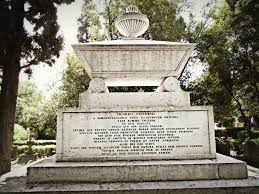
A huge pyramidal mausoleum belonging to Duke of Palmela (1781-1850), born of royal/noble stock and who became the first modern prime minister of Portugal). It houses dukes, family members, friends and servants, it is the largest mausoleum in Europe.
The mausoleum was built in 1849 inspired by Solomon’s Temple, yet externally resembles an Egyptian pyramid – it resembles a church. The Italian sculptor Canova was engaged for parts of the artwork. It can hold up to two hundred bodies.

Amália Rodrigues (1920-1999) was first buried at this cemetery, she was known as the Rainha do Fado, ‘Queen of Fado’ (a popular yet melancholic form of singing).
As was the novelist Aquilino Ribeiro (1918-1963), a Nobel Literature Prize nominee.
Both were later relocated to the National Pantheon, in the Church of Santa Engrácia, which was established as the repository of nationally significant Portuguese individuals. Though some figures have opted for the Jerónimos Monastery or the St. Vincent Monastery as their final resting place.
The cemetery is the final resting place for Portuguese actors, TV talk-show presenters, singers, writers and painters. Surprisingly the cemetery holds the tomb of Henry Fielding, author of ‘Tom Jones’, who died in Lisbon.
–
Punta Arenas Cemetery, Punta Arenas, Chile

This was voted by CNN as one of the most beautiful cemeteries in the World. It was designated as a National Monument of Chile in 2012. It is set on 10 acres (4 ha) in the north of Punta Arenas. It was established in 1894 on land donated by the pioneer Sara Braun – she was later buried here.

In 1981 her house became a Historic Monument known as the Palacio Sara Braun. One entrance has been sealed, apparently at the request of Sara that she was to be only person to go through the gate when she died.
BRIEFER: Sara Braun (1862-1955) was Latvian born, but her Jewish-heritage family fled persecution by the Russian Empire. They first toured Europe, then Argentina and Paraguay, and ended up settling in Patagonia.  She worked there with her father at a Portuguese naval warehouse, she married the Portuguese owner and helped him build a business empire. When he died, she carried on building a commercial, industrial, mercantile, warehousing and importation organisation. She also set up a monopoly in sheep-farming in the area, which led to the genocide of the nomadic Seik’nam inhabitants. She later supported a number of charitable initiatives. |
The engineer Fortunato Circutti designed the portico and the perimeter walls that surround the cemetery.

There are a number of wealthy family crypts here – Blanchards, Brauns, Kusanovics and the Menéndez family.

There are also several oddities and a number of legends:
- Sara Braun is, said by some, to have been embalmed and is disinterred every 1st November to have her makeup reapplied and her hair combed.
- An indigenous Indian was found dead on the island of Diego de Almagro – it was named for a Spanish conquistador. He was buried in this cemetery and the rumour was that he had miraculous powers. His grave attracted thank-yyou notes and coins from visitors. Eventually visitors got together to build a monumental grave and commissioned Edmundo Casanova to create a bronze statue the Indio Desconocido, or unknown Indian. The plaques in the image are thank-yous!

| ASIDE: Edmundo Casanova was also commissioned to produce a bust of Fray Camilo Henriquez, known as the father of journalism in Chile, for his writings and his foundation of the first Chilean newspaper in 1812. It sits on Avenida Cristobal Colón but is heavily vandalised. The graffiti scrawled on it, ACAB is a local usage meaning All Cops Are Bastards.  |
A British sailor, Charles Amherst Milward is buried here. He was the inspiration for a travel classic novel, Bruce Chatwin’s In Patagonia. Chatwin was an English travel writer, who later died in the Peloponnese in southern Greece.
–
Woodlawn Cemetery, New York, USA

This is one of the largest cemeteries in New York. It was commenced, in the Yonkers area of the Bronx in 1863, during the American Civil War.
It is 400 acres (162 ha) and there are some 300,000 people buried here. It contains seven Commonwealth war graves for English and Canadian deceased.

Today, the plot prices were quoted as $850 for a half-plot for cremated remains, $1,350-$1,650 for a full plot and $1,050 for a standard burial. Premium plots have been quoted at $1.5m and they have charged $4.5m for a family mausoleum.

Those buried here include: variety store mogul F W Woolworth, the department store founder Rowland Hussey Macy; authors Herman Melville and Dorothy Parker; film director Otto Preminger; newspaper publisher Joseph Pulitzer; musicians Irving Berlin, Miles Davis and Duke Ellington; gangster Bumpy Johnson; gunfighter and US marshal Bat Masterson…
–
Xoxocotlán Cemetery, Oaxaca, Mexico

This cemetery was founded in 1684, there are two cemeteries in Xoxocotlan – an old one in the centre of town and the new one on the outskirts of Oaxaca. They are usually referred to as Xoxo (and pronounced Ho-ho).

Here they celebrate martes de brujas, or witch Tuesdays, on Tuesdays during Lent. The tradition for these dates back to the colonial period when Friar Domingo de Santamaría managed the construction of a church with volunteers working nights. Women would come to offer tamales and atole to the volunteers, lighting their way with a type of lamp called a ‘bruja’, which contained a candle protected by paper shields. These are today celebrated with tamales and panela cheese along with atole. Atole is a traditional hot corn- and masa-based beverage of Mexican origin, it can have different flavours added such as vanilla, cinnamon, and guava.

But this is more famous as the place to celebrate the Dia de dos muertos, the Day of the Dead in Mexico. This is a time to honour dead loved ones and make peace with the eventuality of death by treating it without any fear and dread.
This holiday is derived from the rituals of the pre-Hispanic peoples of Mexico. Led by the goddess Mictecacihuatl, known as ‘Lady of the Dead’, that traditional celebration lasted a month. But when the Spanish arrived in Mexico, the holiday was moved to coincide with All Saints’ Day and All Souls’ Day (1st and 2nd November). Though 31st Oct is added in some places. Oaxaca spreads the celebrations across four days.

The festivities are often characterized by black humour. In rural areas, families dress graves with candles, cempasuchitl or marigolds, and the foods favoured by their deceased, not to forget the Mezcal, distilled alcohol. Even the poorest locals save money to adorn the graves with flowers and make offerings of cigarettes, chocolate… They are trying to persuade their loved ones to return for a family reunion. In urban areas, people take to the street for celebrations and there is much food and alcohol. Some wear wooden skull masks known as calacas.

Many families build altars, called ofrendas, in their homes, using photos, candles, flowers, and food. These altars have three levels, referring to heaven, purgatory and hell, but sometimes will have seven, reflecting the cosmos of the Zapotec (indigenous people). During the days of celebration these altars may not be touched, for fear of angering the visiting dead.
Those who have loved ones buried in the cemeteries decorate their tombs with flower petals, candles, ceramic skulls and other items, They maintain nightly vigils from early evening until the next morning, with food and drink to sustain them.

Prayers are traditionally said from 11pm until about 3am, prompting the dead to return to the beyond, in peace. Witch Tuesdays and Day of the Dead have been actively promoted by the municipal government in the last twenty years. This is to promote tourism and to counter external influences such as Halloween.
The municipality has sponsored cultural events to run alongside them – musical, gastronomical and other events which attract visitors and residents from the Oaxaca city area.
–
Zentralfriedhof cemetery, Vienna, Austria

One of the largest cemeteries in the world by number of interred (three million), and is the most well-known cemetery among Vienna’s nearly fifty cemeteries. The central in its name is misleading, it is not in the Vienna city centre, but on its southern outskirts. [It is probably second in size only to the Wadi-us-Salaam cemetery in Iraq.]
It was founded in 1863 as the city’s population expanded beyond the capacity of the communal cemeteries. No-one foresaw the fall of the Austria-Hungarian Empire in 1918, and in fact they forecast that Vienna would have four million inhabitants by the end of the 20th century – it was in fact two million at that point. So, the land set aside for the cemetery proved to be an over-estimate.

The Zentralfriedhof is 620 acres (250 ha). A regular Viennese joke is that the cemetery is ‘half the size of Zurich, but twice as much fun’. It has 330,000 gravesites.
It was designed in 1870 and opened on All Saints’ Day in 1874, with the burial of Anton Seifert, a military bandmaster and composer.

In addition to the Catholic section, the cemetery has a Protestant cemetery (opened 1904) and two Jewish cemeteries – which has caused some controversy along the way. The older Jewish cemetery was destroyed by the Nazis during the Kristallnacht (9-10 November 1938). Prominent in the Jewish cemetery are members of the Rothschild family.
Islamic burials have been made here since 1876, though the deceased have to use the Austrian approach of burial in a coffin, instead of a shroud. Russian, Greek and other eastern Orthodox burials have been made here. In 2005 the cemetery performed its first Buddhist funeral. An area was established for a stupa, which was consecrated by a Tibetan monk. In 2009 a one hectare plot was set aside for the deceased of The Church of Jesus Christ of Latter-day Saints (Mormons).
In the year 2000 a baby burial ground was opened where stillborn infants, dead babies, and young children up to 110 centimetres (43 in) in height are interred. In 2009 an Anatomy Memorial was opened for burials from the Institute of Anatomy of the Medical University of Vienna – for those people who donate their bodies to science.
St. Charles Borromeo Cemetery Church, in the Art Nouveau style, is the central church of the cemetery. The crypt of all the post WWII Austrian presidents is set in front of the church, a burial vault is located beneath the sarcophagus, with stairs leading to a circular room lined with niches, where urns or coffins can be interred.

Its main claim to fame is those who are buried here – Ludwig van Beethoven (d1827) and Franz Schubert (d1828), were moved here from Währinger Ostfriedhof in 1888. It is also the final resting place of Johannes Brahms (d1897), Antonio Salieri (d1825), Johann Strauss (d1899 – and other Strauss family members) and Arnold Schönberg (d1951). A cenotaph in the cemetery also honours Wolfgang Amadeus Mozart, though he is buried in the nearby St Marx Cemetery.

Hedy Lamarr, the Hollywood star, is here, but her tomb design acknowledges her second career as an inventor:

Also here are architects, artists, engineers, footballers, industrialists, playwrights, scientists, sculptors…
The cemetery is alo a habitat and it contains the rare European hamster.
–
Other notable cemeteries

John F Kennedy’s eternal flame at Arlington
These forty are often mentioned in compilations of interesting and/or beautiful cemeteries:
- Aoyama Cemetery, Tokyo, Japan
- Arlington National Cemetery, Arlington Virginia, USA
- Bonaventure, Savannah Georgia, USA
- Calvary Cemetery, New York City NY, USA
- Calverton National Cemetery, Calverton NY, USA
- Cementerio General, Santiago, Chile
- Chichicastenango Cemetery, Guatemala
- Cimitero Monumentale di Staglieno, Genoa Italy
- Cmentarz Powazki, Warsaw, Poland
- Crown Hill Cemetery, Indianapolis, IN, USA
- Fadiouth Shell Island, Joal-Fadiouth, Mbour, Senegal
- Forest Lawn, Los Angeles, CA, USA
- Glendalough Graveyard – County Wicklow, Ireland
- Granary Burying Ground, Boston, Mass USA
- Green-Wood Cemetery, Brooklyn, NY, USA
- Gubbio Cemetery, Mount Ingino, Umbria, Italy
- Il Cimitero Acattolico di Roma, Rome, Italy
- Issyk-Kul cemeteries, Kyrgyzstan
- Karacaahmet Cemetery, Istanbul, Turkey
- Ketchum Cemetery, Sun Valley Idaho, USA
- Kingston Cemetery, Norfolk Island, Australia
- Lone Fir Cemetery, Portland, Oregon, USA
- Makomanai Takino Cemetery, Japan
- Maqbaratol Shoara, Tabriz, Iran
- Mirogoj Cemetery, Zagreb, Croatia
- Mount Auburn Cemetery, Cambridge Massachusetts, USA
- Myra Necropolis, Turkey
- Neptune Memorial Reef, Key Biscayne, Florida, USA
- Ohlsdorf Cemetery, Ohlsdorf, Germany
- Okunoin Mount, Koya, Japan
- Petersfriedhof (St. Peter’s Cemetery), Salzburg, Austria
- Rockwood Cemetery, Sydney, Australia
- São João Batista Cemetery, Rio de Janeiro, Brazil
- Sary Kamysh Cemetery, Kyrgyzstan
- Skogskyrkogården Woodland Cemetery, Stockholm, Sweden
- South Park Cemetery, Kolkata, India
- Spring Grove Cemetery, Cincinnati, Ohio, USA
- Sunset Chapel, Acapulco, Mexico
- Merry Cemetery, The – Maramures or Sapanta, Romania
- Varenna Cemetery, Lake Como, Italy
Cemeteries: Forward to Famous Burials - Back to Other faiths
Back to Next tier of religions – Religions – Death
Back to Adieu Index - Back to Bob Denton home page


