Adieu, the final farewell, an exploration of death!

Introduction: Forward to Death
Back to Adieu Index - Back to Bob Denton home page
–
We die only once, and for such a long time.
Molière, French playwright, actor, and poet
–
Death is the cure for all diseases.
Sir Thomas Browne, English author and polymath
–
I’m not afraid to die, I just don’t want to be there when it happens.
Woody Allen, American filmmaker, actor and comedian
–
By ‘an exploration of death’, we are not referring to the sort of investigation that a coroner might make, pehaps requiring post-mortems and inquests.
We mean the subject, the science, the beliefs and customs about death.
Death is (so far?) an inevitable consequence of life, all living things must die and their bodies decompose.

We have a deep-rooted instinct for self-preservation and so most humans are at least anxious, and often fearful, of death as a notion. Death anxiety is a global phenomenon, though much affected by different cultural and religious factors.
There are even scales created to measure it. The Multidimensional Fear of Death Scale encompasses the fear of conscious death, the fear for the body after death, fear of the dying process, fear of the unknown and the fear of being destroyed. Then there is the fear of premature death, the fear of the dead themselves and fears for the surviving significant others. I would expand the first factor, the dying process, into the fear of how death actually occurs and concerns that it might be painful, and worse, be long-winded about it!
The Fear of Personal Death Scale looks at the intrapersonal, interpersonal and transpersonal. Intrapersonal includes the loss of self-fulfilment and self-annihilation. Interpersonal includes the loss of social position, the consequences for family and friends. Transpersonal is more about the transcendental consequences, the fears of the potential for punishment in the hereafter.
The Collett-Lester Fear of Death Scale focuses on the death of self, the dying of self, the death of others and the dying of others. It considers these main heading among 28 sub-headings. It is regularly used, but it is also regularly criticised that its structure in unstable.

These scales agree that this anxiety and fear exists, and note that some individuals compensate for this fear by deliberately pursuing activities and pastimes with some risk attached, others use funereal humour to deflect from and mask their anxiety, others simply choose to deny the whole topic.
Different cultures approach the subject in a variety of ways. Some cultures view death as a finality, the final curtain, the end. Others view it as a moment of transition, the individual continues to exist albeit in some other form of existence. Some view it as a repeating pattern of birth, death and rebirth. Some consider that the dead continue to interact with the living.
These cultural beliefs do influence the way in which we live, they create different concepts of how individuals consider, approach and fear death. Of course it also affects the ways in which death is mourned and the ritual of resulting funerals and memorials.
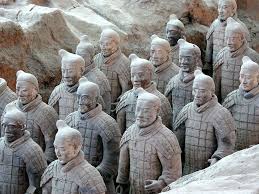
The Terracotta Army depicts the armies of Qin Shi Huang, the first emperor of China.
It had the goal of protecting him in his afterlife (210–209 BCE).
In the UK we are very squeamish about discussing or referencing death. Our most common euphemism for death in English is to say the person has ‘passed away’ or ‘passed’. Passed what? Passed the Cycling Proficiency test? Passed the traffic lights on red? Passed the night away in a bar? Passed the MoT? Passed me the biscuits? Passed an intrusive new law? Passed judgement on the décor of someone’s home? Passed the opening bid of 2NT? Passed faeces?
However, passed away is to some extent reassuring because it sounds like the person moved on, implies that there may be something after death.
 ASIDE: I recall, when we lived in Byfleet Surrey, there had been an open field behind our house, separated by a hedge of elm, which was dying from the then current Dutch Elm Disease. To one side was a school playground and across it was a church. The church took command and had someone consecrate the land. Then it promptly started burying people along our hedge-line, just twenty feet from our dining room! We were in the process of selling the house and I remember doing extended research using Roget’s Thesaurus to decide that the most acceptable word for a graveyard was ‘churchyard’. We therefore described it as an extension of the churchyard. We needn’t have bothered the purchaser smiled and asked if this was ‘the dead centre of Byfleet’. |
We do skirt around the subject of death.
Forward to Death
Back to Adieu Index - Back to Bob Denton home page


