Adieu, the final farewell, an exploration of death!

Christian: Forward to Islam – Famous Cemeteries
Back to Six largest religions – Religions – Death
Back to Adieu Index - Back to Bob Denton home page
–
Quick Links:
Almost a third (32%) of the world declares itself as Christian, that is some 2.4bn people.

These are made up 26% of Europeans, 37% of Americans (north and south), 24% of sub-Saharan Africans,13% of Asia Pacific inhabitants and just 0.6% in the Middle East and North Africa (MENA).
| [Factoid: Christianity originated in the Middle East, yet only 0.6% of those in the Middle East and North Africa still follow its teachings today.] |
–
Globally there are a total of over 45,000 Christian denominations, however around 50% of Christians are Catholic, 37% are Protestant, 12% are Orthodox, and this leaves the final 1% to encompass the Mormons, aka Latter Day Saints, (16.6m), Jehovah’s Witnesses (8.5m), Christian Scientists (400k)…
–
Catholicism actually consists of twenty-four autonomous churches, though the Vatican considers itself to be the central authority.

These churches pursue six different rites:
| Latin Rite – the Roman Catholic church; | Armenian Rite – the Armenian church; |
| Alexandrian Rite – the Coptic, Eritrean and Ethiopian Churches; | Chaldean Rite – the Chaldean and Syro-Malabar churches; |
| Antiochene Rite – the Maronite, Syriac and Syro-Malankara churches; | Byzantine Rite – fourteen Eastern Orthodox religions – Russian, Greek… |
–
Protestant is something of a catch-all term.

Protestantism includes:
| Adventists; | Methodists; |
| Anabaptists; | Pentecostalists; |
| Anglicans; | Presbyterians; |
| Baptists; | Plymouth Brethren; |
| Calvinists; | Quakers; |
| Congregationalists; | Reformed; |
| Episcopalians; | Salvation Army; |
| Evangelicals; | Unitarians… |
| Lutherans; |
Each has a central authority for its denomination.
Therefore, to discuss Christian customs and rites this section has to remain fairly general in its scope.
–
Christian articles of faith are:
- to believe in the one God;
- to believe in the Trinity – Father, Son and Holy Ghost;
- to believe in the crucifixion and resurrection of Christ;
- to believe in the three creeds – Nicene, Athanasian and Apostles’;
- to believe that we have free will but that we will be held accountable for our sins;
- to believe that scripture contains everything necessary to achieve salvation;
- to practise and observe the sacraments – baptism, confirmation, the Eucharist, penance, holy orders, matrimony, and the anointing of the sick.

Note in that list of sacraments there is no mention of the funeral. This is based upon the belief that the deceased has passed, and so is beyond all of the sacraments. The fundamental belief is that, when a Christian dies, it is the end of that individual’s life on Earth.
–
If practicable the dying person is attended by a minister who prepares the individual for the afterlife, relieves any anxiety and provides solace. The minister absolves them of sin, then at their end, reads the Last Rites, a final blessing in prayer to help them smoothly into the hereafter.
Catholics perform a number of sacraments at this time – confession, absolution, anointing (or extreme unction) and a viaticum communion (literally ‘provisions for a journey’) to provide them with sustenance while travelling into the afterlife.
–
When a death is confirmed some form of death certification is required.

It is illegal in Britain not to register a death, and if the death:
- was violent or suspicious;
- or, as the result of an industrial disease;
- or, happened as a result of surgery or an aesthetic;
- or, took place while held in custody;
- or, the deceased has not been seen for 28 days by a doctor;
- or, where the cause of death is not known or unsure.
In these circumstances a coroner is asked to investigate, and may request a post-mortem.
Where none of these apply then the body used to be laid out in their home’s parlour within a coffin; as much for later ease of transportation. The coffin was also a matter of paying respect for the individual.
–
Friends would sit with the body during the day, family then keep watch overnight, to avoid evil spirits.

This also allows for the uncertainty about when the spirit actually leaves the body. Today the laying-out is more often at a funeral parlour.
–
Flowers and candles are used to mask any smells. White lilies have been the most popular as they are considered to represent the innocence of the soul.
The choice of flowers may be a matter of the deceased or the deceased’s family’s preference.

Traditionally their meanings were:
- white flowers represent elegance, reverence, purity, innocence and eternal love;
- red flowers signify strength, respect, devotion and love;
- pink flowers represent grace, compassion and innocence;
- orange flowers signify enthusiasm, joy and warmth;
- yellow flowers signify friendship, warmth and hope;
- green flowers signify nature, wellness and renewal;
- blue flowers represent sadness, sympathy and peace;
- purple flowers represent respect, sorrow, sympathy and admiration.
–
The date and time of the funeral is then announced publically in the local media detailing any special considerations like flowers, charitable donations and so on. Mourning is considered to last for around a week and the burial usually arranged during this timeframe.

A lych-gate is a roofed porch-like gate to the churchyard, traditionally the deceased and coffin were placed under its shelter until the funeral, often for a day or more. These have seats for vigil watchers – to keep the body-snatchers away!
A church funeral service is held for friends and family, both to grieve the loss and to celebrate the life of the deceased. This is of course a precursor to the committal of the body. The body in its coffin is transported to the church in a hearse, with mourners following in vehicles behind. If the distance permits, then the vehicles can be replaced by a procession on foot behind the hearse.

A number of superstitions surround the funeral service. You should not yawn because spirits might enter your mouth. It is said to be bad luck if you wear anything new to a funeral. Some suggest mentioning the deceased’s name puts the close family at risk, and may mean the deceased’s spirit cannot find peace. If rain falls or if there is thunder that is assumed to be positive, it is the deceased entering Heaven.
–
The tradition was then to be buried in the church graveyard, though today some 75% are cremated. Burials usually therefore require a procession, or cortège, to the graveside. Once the coffin has been lowered into the grave it had been the practice to drop a handful of earth or flowers down onto the coffin.
| [Personal memory: we buried my Dad in his father and mother’s grave plot. Grandad, Dad and I were all named Robert Soulsby Denton. So, as Dad’s coffin was lowered into the reopened grave, I could see both the gravestone for the first Robert Soulsby, and a plaque on the coffin displaying the name of the second. As the third, I stood at the graveside. That was a surreal experience.] |
The burial process is also called an interment or inhumation. After interment it became the tradition to erect a marker, gravestone or monument.

The elite were often buried in a sarcophagus or family crypt or vault. The more significant individuals would be sited within the church, and might be granted the right to have a ledgerstone (an inscribed stone slab in the floor of the church) or be placed beneath chancels, naves and the transept inside a church, some were marked by the use of effigies of the deceased. The very rich funded a chantry chapel where their memory is assured of routine celebration by a cleric.
–
| [Personal memory: My father was a fireman and they seemed to be able to access all sorts of strange part-time jobs, and while a teenager my father helped me to take a variety of roles. Perhaps the oddest job I did was gravedigging. This was back when a grave was dug by hand, not with some form of mechanised digger. It proved to be exacting hard work, particularly in Bristol where clay abounded. I can’t resist telling one story that the sexton told me. I don’t care if it wasn’t true, it’s a great anecdote. Graves were let to their occupants for 99 years (other graveyards may vary). After that it was assumed that there was only a skeleton left and, by then, probably few would remember the deceased, so the plot was agreed to be reallocated. 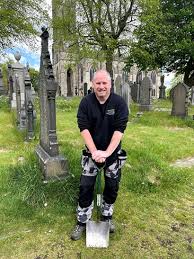 The story told of a grave digger working down at around six feet and using a pickaxe on account of the local clay. It was dusk as he swung hard and there was a deep ‘waaughh’ noise from beneath his feet. He was out of the hole and across the churchyard in no time. He burst into a pub and had several double scotches before he could tell anyone what had happened. You need to appreciate that most coffins from earlier times were fabricated in elm, a wood preserved by the water held in clay. His pickaxe had gone through the lid of such a preserved coffin in a reclaimed grave. The decay of the body inside had created a vacuum which his pick axe had pierced and this had created the noise. That job didn’t last long. I quit when digging down to six feet where a relative had been buried at eight feet just a few months earlier. It took a week to get the smell from my nostrils – and much longer from my mind.] |
For churchyard burials the grave is dug lying east-west, the body is interred in the supine, lying down, position and face up. The arms may be crossed, or arranged to be in prayer. The grave is traditionally dug to six-feet deep to mask the odour and avoid the spread of diseases, it also helps to prevent predation. This was also deep enough originally to avoid any chance of being disturbed by later ploughing.
Any grave marking is placed at the head of the deceased. The deceased faces east, as it is considered that Christ’s second coming will be from the east, so the deceased is ready to greet him. Priests were however buried facing west so that they would be facing towards their congregation. Criminals were often buried face down to mark their wrong-doing.
–
Cremations usually place the ashes in an urn, which may be retained at home, or disbursed in some memorial location.

It has become the practice to ask relatives to spread the ashes in some rather evocative location. Most recently the ashes can be fashioned into a pseudo-gemstone or fired off into the ether as part of a rocket.
| [ASIDE: a friend’s father was a boatman on the Thames and was often asked to take out family members to spread their deceased out over the river. My friend said his father was quite quick to take a dislike of people. Where he did he would often turn the boat into the wind so that the ashes blew back into the boat!] |
After death there is believed to be a judgement made, so that those who have had led a righteous life are rewarded by going to heaven, those who did not go, via Purgatory, to Hell.
It is traditional to hold a wake at the home of the deceased.
Christian Denominations
There is a whole raft, or pot pourri of Christian beliefs. The differences are often subtle, but centre upon their belief in the nature of the Trinity, in the nature of Christ, or upon biblical interpretations, or the views of apostles and bishops, and upon their actual customs and rituals.
Above we already grouped Catholicism and Protestantism, but there are many more, which we will look at by size of followers.
Pentecostalism
This was founded by Charles Fox Parham in Topeka, Kansas in 1901. The Pentecostal/Charismatic movement is one of the fastest-growing trends in World Christianity today. It claims 644 million adherents.
This denomination focuses on the Holy Spirit and believes in direct personal experience of God through baptism with the Holy Spirit. It believes in talking-in-tongues and in supernatural healing. It believes that the second coming is imminent.
It has no central body to unify its 700 denominations. Other than this, it is a fairly traditional Christian movement.
Its funeral service is rather more animated than other denominations and burial is certainly preferred, but otherwise traditional.
Eastern Orthodox
Eastern Orthodoxy, this is a fellowship for a whole series of Eastern European denominations, run by bishops and synods. It believes it is the direct successors of Christ’s Apostles. The Virgin Mary has a significant role in the Orthodox Church.

It split from the Catholic Church in 1054 CE, this is known as the Great Schism. These churches have 220m baptised followers making it the fourth-largest religion in its own right. It has no equivalent of the Pope or the Vatican.
It has been hugely influential in the culture and religion of Eastern and Southeastern Europe, the Caucasus and Western Asia.
Its funeral service is similar to the Catholic approach, with a more ornate procession, an open casket is used and the offerings made are different. Cremation is not permitted, and organ donation policy is unclear.
Anglicanism
This is a Protestant denomination that claims 110 million adherents worldwide.

Its funeral customs are as described under Christian.
Lutheranism
Lutheranism claims to have 81 million adherents. It is a major branch of Protestantism, identifying primarily with the theology of Martin Luther, the 16th-century German reformer who sparked the Protestant Reformation.
It has a fairly conventional Catholic funeral, though its service includes more elements of worship including a Holy Communion.
Methodism
This denomination claims 75 million adherents. The term originated at Oxford in the 1730s. Certain students, including John and Charles Wesley, formed themselves into what was also called ‘The Holy Club’. They lived by ‘method’, so this name was applied to them.
It was founded around the preaching of John Wesley from 1739 which spanning fifty years and a remarkable 250,000 miles travelled. Methodist was considered evangelical and inspired branches, Calvinist Methodist, Wesleyan Methodist and Nazarene.
Its funerals are conventional Christian.
Baptist
This denomination suggests it has 51 million baptised members worldwide, with 253 fellowships and 176,000 churches in 130 countries.

The denomination’s origins are still disputed, some suggesting it dates back to the Anabaptists, others much later. It is a Christian evangelical church based on belief. Their shared beliefs include one God, the Trinity, the virgin birth, Christ’s resurrection, the Second Coming, the Kingdom of God and immersion baptism.
Their funeral customs are traditional.
Seventh-Day Adventists
This has 22 million adherents in 212 countries. It was founded in 1863 by co-founders, one of whom was the author, Ellen Gould White (she was also a proselytising vegetarian). She is said to have had over 2,000 visions of God and described and published these. As their name suggests they celebrate
the Sabbath as Saturday. They believe in the Trinity as one God, and they believe that scripture is infallible. There is a central body and it supports a set of 28 fundamental beliefs. These are quite traditional for an evangelical Christian.
Their funeral is traditional permitting burial and cremation.
Scientology
This was founded in 1954 by author L Ron Hubbard, and claims 10 million followers, but there are many sources that place this as significantly lower. It also cites 11,000 churches, missions and groups in 184 nations.

Notable members include John Travolta and Tom Cruise. Hubbard did not get some sort of spiritual revelation, instead he described his writing as ‘applied religious philosophy’. It is described as a religion of practice rather than one of belief.
Hubbard suggested the Thetan is the essence of the person, living in the MEST, matter, energy, space and time. The Thetan is reborn in another body. While scientologists do reference a Supreme Being they do not worship or pray to it. They hold rituals to achieve spiritual transformation.
Their rites of passage like weddings and funerals are quite conventional.
Salvation Army
There are 1.7m Salvationists in 133 countries, these are designated as soldiers, officers and adherents. The movement was founded in 1865 CE by William and Catherine Booth. It is essentially derived from Methodism. It however does not perform the sacraments of baptism or holy communion.

Its practical activities are to run charity shops, to operate shelters for the homeless, and provide disaster relief and humanitarian aid to developing countries.
It has a central authority that operates through five regions Europe, America and the Caribbean, Africa, South Asia, South Pacific and East Asia.
Its funerals are traditional Christian, with a slight military flavour.
Unitarianism
This was founded in 1774 CE and has 800,000 followers. It believes in the unitary nature of God. Jesus was inspired by God to become the redeemer. So, they do not believe in the Trinity.
It is a fast-growing denomination.
Its funeral has a church minister deliver a sermon and meditation, a eulogy is delivered by a family member and there is a musical selection. It is presaged by visitations to the home but a closed coffin is used.
Quakers
Today there are 400,000 Quakers in 87 different countries. They follow the Religious Society of Friends, a Christian denomination founded in 1552 following the English Civil Wars. The founder was George Fox. They were initially persecuted for their blasphemous views, for their refusal to swear oaths, for their pacifism and their refusal to remove hats in the presence of government officials.
They believe in God continuing to reveal the truth to individuals. Their beliefs vary according to their community, but these can be expressed as testaments to the spiritual equality of all people, to simplicity, integrity, pacifism and consensus.
Their funeral customs are quite traditional but focus on contemplation rather than hymns, and flowers are not commonly sent.
Opus Dei
This was founded in 1928 by a Catholic priest called Josemaria Escrivá de Balaguer with the prior agreement of Pope Pius XII. Pope John Paul II gave it his blessing in 1982. There are 95,000 members, 2,000 of whom are priests.

Opus Dei means ‘Work of God’. The members offer spiritual assistance and training for ordinary Catholics to understand how their life can grasp the idea of holiness. It was originally men-only but began to admit women from 1930.
Opus Dei, formally known as the Prelature of the Holy Cross and Opus Dei, is an institution of the Catholic Church, whose members seek to implement Christian ideals in their occupations and in general society. It seeks to unify spiritual life with professional, social and family life, and to find God in everyday life.
They believe in regular prayer, and more controversially in mortification. The subject themselves to self-afflicted pain and discomfort, a way of emulating Christ’s pain. Opus Dei runs residential centres throughout the world, and establishes social initiatives, including schools and training centres.
Their funeral practices are those of the Catholic Church.
Christadelphians
This was founded by John Thomas in Brooklyn NY USA, in 1848, just before the American Civil War. Estimates place the membership at 50,000 in 120 countries.
He had studied the Bible and drew his own conclusions and interpretations. The religion asserts that the Bible is the sole basis of their beliefs. Thomas took the name Christadelphian, meaning Christ-brothers. There is no central authority, though there are some international Christadelphian organisations.
They do not believe in the Trinity. They believe that Jesus was the Messiah, the Son of Man and not God. They do not have a Hell or the Devil. They believe that at death the deceased’s soul does not have immortality, instead it enters an unconscious state, from which believers will be resurrected at the time of the Second Coming, which they believe will be in Israel.
Funerals are quite traditional, practicising burial and cremation. A family member gives a eulogy and there is a procession to the grave side. Some Christadelphians do object to post mortems and to organ donation.
Christian: Forward to Islam – Famous Cemeteries
Back to Six largest religions – Religions – Death
Back to Adieu Index - Back to Bob Denton home page


