Forward to 1.2.4 Carolingian, Ottonian – 1.3 Renaissance to Romanticism (1300-1800)
Back to 1.2 Medieval – 1.2.2 Visigoths Vikings – Back to 1 Art and Sculpture
The Byzantine Empire was the eastern half of the Roman Empire, which lasted from 330–1453 CE. The empire’s early and middle periods were marked by the development of its own art, architecture, and political systems.
[1230-10]
| Part of ivory diptych of Areobindus Dagalaiphus. In Late Antiquity, a consular diptych was a type of diptych intended as a de-luxe commemorative object. The diptychs were generally in ivory, wood or metal and decorated with rich relief sculpture. A consular diptych was commissioned by a consul ordinarius to mark his entry to that post, and was distributed as a commemorative reward to those who had supported his candidature or might support him in the future. This one is of Areobindus Dagalaiphus, consul in 506, showing him in an imago clipeata. |   Image source: Wikimedia commons [1230-11] |
 Image source: Wikimedia Commons [1230-12] | The ‘Archangel ivory’ is the largest surviving Byzantine ivory panel, now in the British Museum in London. Dated to the early 6th century, it depicts an archangel holding a sceptre and imperial orb. |
| This is a 6th-century illuminated Syriac Gospel Book. One of the finest Byzantine works produced in West Asia, and one of the earliest Christian manuscripts with large miniatures, it is distinguished by the miniaturist’s predilection for bright colours, movement, drama, and expressionism. Created during a period from which little art survived, it nevertheless saw great development in Christian iconography. The manuscript has a significant place in art history, and is very often referenced. |  Image source: Wikimedia commons [1230-13] |
 Image source: Wikimedia commons [1230-14] | Mosaic of Emperor Justinian I and Theodora. Justinian, born in 482 AD as Petrus Sabbatius, a peasant from Thrace (modern-day Macedonia). His family owned a farm, and so he would have probably grown up to be a farmer–if it wasn’t for his Uncle Justin. Uncle Justin had joined the Roman army in his youth, and had worked his way up in the military to become Commander of the Excubitors (a kind of palace guard) in the empire’s capital at Constantinople. Once in command, Justin invited his young nephew to come and live with him in the city where Petrus lived for 20 years, gaining an education and experience in the court of the emperor. Emperor Anastasius passed away on 9 July 518 AD at 87 years of age, leaving behind no heir to the throne. In this way, Justin – as Commander of the Excubitors – found himself in a very interesting and strategic position. The senate, a symbolic body of aristocrats, opened the day after the emperor’s passing to ‘debate’ the matter of succession while Justin’s troops gathered the citizens of the city in the Hippodrome, a grand racing arena built to hold over 100,000 people. Discussions on the emperor’s successor fell into disarray. Eventually Justin came down as commander to establish order. His soldiers bowed down to him and acclaimed him as their new emperor. Source: thebyzantinelegacy.com/demetrios-thessaloniki |
Mosaic of St Demetrius with the Founders, Hagios Demetrios, Thessaloniki. The decoration of Hagios Demetrios are the dedicatory mosaic panels, offered by ordinary citizens and officials of the city. Only nine of these mosaics, on the two large piers at the east of the sanctuary and the west wall of the nave, escaped the great fire of 1917. These mosaics, which cover the period from the 5th to the 9th century | 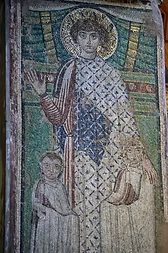 Image source: [1230-15] |
 Image source: Khan Academy [1230-16] | Saint Catherine’s Monastery, at Mount Sinai (Egypt) has the remarkable painting of the Virgin (Theotokos) and Child between Saints Theodore and George. This shows an Enthroned Virgin and Child flanked by two soldier saints, Saint Theodore to the left and Saint George at the right. Above these are two angels who gaze upward to the hand of God, from which light emanates, falling on the Virgin. It is said that the composition displays a spatial ambiguity that places the scene in a world that operates differently from our world, reminiscent of the spatial ambiguity of the Ivory panel with Archangel (featured above). The ambiguity allows the scene to partake of the viewer’s world but also separates it from the normal world. (Khan Academy) |
 Image source: Wikimedia commons [1230-17] | The David Plates (or Cyprus Plates) are a set of nine silver plates, in three sizes, stamped between 613 and 630. The plates were created in Constantinople, each depicting a scene from the life of the Hebrew king David, and associated with the reign of Emperor Heraclius (610-641). This is the largest and it features David’s fight with Goliath. |
| The Cross, Hagia Irene, Istanbul. The Hagia Irene stands on what is believed to be the oldest site of Christian worship in Istanbul. Roman Emperor Constantine I ordered the church in the 4th century, making it the first church built in Constantinople. After being burned down during the Nike revolt in 532, Emperor Justinian I had the church restored in 548. By then the Patriarchate had already moved to the Hagia Sophia, which was completed in 537. Restorations were again required in the 8th century after severe damages caused by an earthquake. |  Image source; [1230-18] |
 Image source: Wikimedia Commons [1230-19] | St Luke, Hosios Loukas, Distomo aka Luke of Steiris, (896-953 CE) was a Byzantine saint of the tenth century who lived in the themes (provinces) of Hellas and Peloponnese in Greece. He founded the Monastery of Hosios Loukas (Venerable Luke) on the slopes of Mount Helicon, between Delphi and Levadia in Boeotia, Greece. He was one of the earliest saints to be seen levitating in prayer. |
| The Ascension, Hagia Sophia, Thessaloniki – The mosaic in the dome represents the Ascension with the inscription from Acts 1:11 “Ye men of Galilee, why stand ye gazing up into heaven?”. The dome is ringed by the figures of all Twelve Apostles, Mary and two angels. (Source: pallasweb.com) |  Image source: pallasweb.com [1230-20] |
 Image source: [1230-21] | Harbaville Triptych, ivory, is a a Byzantine ivory triptych of the middle of the 10th c CE with a Deesis and other saints. Traces of colouring can still be seen on some figures. It is regarded as the finest, and best-preserved, of the “Romanos group” of ivories from a workshop in Constantinople, probably closely connected with the Imperial Court. This is 28.2 x 24.2 cms. It is at the Louvre. |
| David Composing the Psalms, from the Paris Psalter, c. 900 C.E. 14-1/8 x 10-1/4″ / 36 x 26 cm (Bibliothèque nationale de France) |  Image source: [1230-22] |
 Image source: /art.thewalters.org/ [1230-23] | Saint Arethas was an Ethiopian soldier who was murdered in 523 because of his Christian faith. He is depicted here in Byzantine court dress, holding a cross as a sign of his martyrdom. The tile is one among three in the Walters Art Museum that have the same size and contain identical busts of male saints: the other two show Saint Basil (inv. 48.2086.17) and Saint Panteleimon (inv. 48.2086.4). This series probably formed a frieze on a church wall or altar screen. |
| Mosaic of Daphni Monastery located seven miles from Athens, and heavily damaged by earthquakes. |  Image source: pallasweb.com [1230-24] |
 Image source: Wikimedia Commons [1230-25] | Theotokos of Vladimir, Tretyakov Gallery, Moscow – a 12th-century Byzantine icon depicting the Virgin and Child and an early example of the Eleusa iconographic type. It is one of the most culturally significant and celebrated pieces of art in Russian history. Many consider it a national palladium with several miracles of historical importance to Russia being attributed to the icon. Following its near destruction in the thirteenth century, the work has been restored at least five times. |
| Frescoes in Nerezi near Skopje. The Eastern Roman Byzantine Empire is well known for its glittering, gold mosaics. But the medieval artists of Byzantium were also adept at a wall painting technique known as fresco: a less expensive medium than mosaics in which artists applied pigments to wet plaster so that the painting became chemically bonded to the wall itself. A small church located in the village of Gorno Nerezi (commonly just Nerezi) on the outskirts of Skopje, North Macedonia, preserves some of the finest examples of fresco from the Byzantine period. |   Image source: Smart History |
The Merovingian dynasty was the ruling family of the Franks from around the middle of the 5th century until 751.They first appear as “Kings of the Franks” in the Roman army of northern Gaul.
[1230-30]
| Mid 6th c Merovingian Architectural Ring with a garnet. |  Image source: Met Museum [1230-31] |
 Image source: [1230-32] | Merovingian looped fibula – mid-6th century, silver gilt worked in filigree with inlaid garnet and other stones. Held at the Musée des Antiquities Nationales, Saint-Germain-en-Laye. |
| Dagobert I (c603-639), Merovingian king of Austrasia, all the Franks, 629-634, and of Neustria and Burgundy, 629-639. Together with the reign of his father, Chlothar II, the period of Dagobert’s rule has been characterized as the peak of Merovingian power. However, Dagobert was the last king of the Merovingian Dynasty to exercise any significant royal authority. |  Image source: armedconflicts.com [1230-33] |
 Image source: themorgan.org [1230-34] | Gospel Book – Books played a crucial role in establishing networks of power. Over twenty Carolingian manuscripts name Hincmar of Reims as donor, and many more are associated with his patronage. Most were created for use in and around Reims, but their influence was widespread. This Gospel book features two evangelist portraits and the beginnings of a third, all drawn in a distinctly Reimsian style. While to a certain extent unfinished, the heavy use of shading—as evident in this image of the evangelist Luke—suggests that the portraits were never intended to be painted. |
| Gellone Sacramentary is a late 8th century illuminated manuscript. It is recorded in Saint-Guilhem-le-Désert Abbey at the start of the 9th century. It is now in the manuscripts department of the Bibliotheque Nationale de France. Its style is directly influenced by Merovingian illumination. |  Image source: Wikimedia Commons [1230-35] |
 Image source: Wikimedia Commons | Gospels of St Medard of Soissons – a 9th-century illuminated manuscript gospel book, and is a product of the Court or Ada School of the Carolingian Renaissance. |
Forward to 1.2.4 Carolingian, Ottonian – 1.3 Renaissance to Romanticism (1300-1800)
Back to 1.2 Medieval – 1.2.2 Visigoths Vikings – Back to 1 Art and Sculpture


